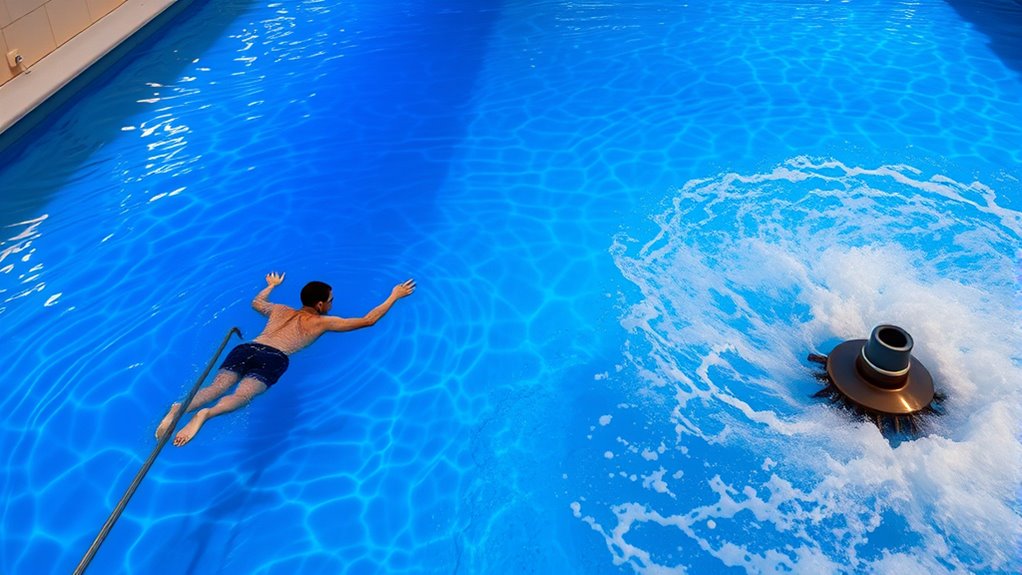

Tethered swimming keeps you stationary, allowing you to focus on technique, breathing, and form without external water resistance. It’s ideal for refining stroke efficiency and maintaining controlled breathing in a stable environment. Powered current, on the other hand, mimics real swimming conditions by providing resistance and requiring you to adapt your breathing and pacing. Combining both methods can boost your overall performance—discover more ways to improve your swim skills as you continue exploring.
Key Takeaways
- Tethered swimming provides a stationary environment to focus on form and breathing without water resistance.
- Powered current offers adjustable resistance, simulating real swimming conditions and challenging endurance.
- Tethered setups facilitate precise technique analysis, while powered currents help develop adaptability in dynamic flows.
- Tethered swimming emphasizes controlled breathing and stroke efficiency, whereas powered currents enhance stamina and resistance training.
- Combining both methods in Endless Pools offers comprehensive training for technique refinement and performance endurance.
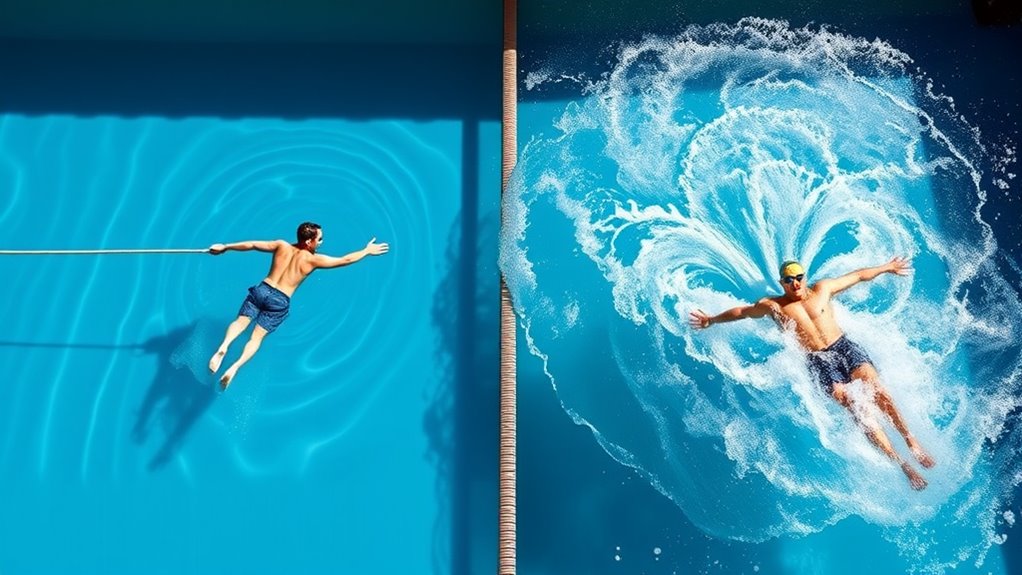
Have you ever wondered which swimming method—tethered swimming or powered current—is more effective for training? Both techniques offer unique benefits, but understanding how they impact your breathing techniques and stroke efficiency can help you make the right choice. When you swim with a tether, you’re connected to a fixed point, which allows you to focus intensely on your form and pacing. This setup encourages you to refine your breathing techniques because, without the distraction of maintaining forward momentum, you can concentrate on the rhythm of your breaths. You might find that in tethered swimming, your breathing becomes more controlled and deliberate, helping you develop better lung capacity and consistency. Plus, since your body remains stationary, it’s easier to analyze and improve your stroke efficiency. You can isolate movements, identify inefficiencies, and work on smooth, powerful strokes without worrying about external factors like current or water resistance. Incorporating goal setting techniques can further enhance your training focus and motivation.
On the other hand, powered current in an Endless Pool introduces a different training dynamic. The current simulates real swim conditions, forcing you to adapt your breathing techniques to maintain rhythm against resistance. This method better mimics open-water or competition swimming, so your breathing becomes more natural and adaptable. As you push against the current, you’re compelled to develop a more efficient stroke to conserve energy, which directly enhances your overall stroke efficiency. The constant resistance also challenges your body to work harder, improving muscular endurance and cardiovascular fitness. Over time, this leads to a more seamless integration of breathing and stroke technique, as you learn to synchronize breath with movement under more realistic conditions.
Both methods enhance your stroke efficiency, but they do so in different ways. Tethered swimming allows you to focus on precision, perfecting your form and breathing patterns in a controlled environment. Conversely, swimming against a powered current trains you to maintain efficiency under resistance, preparing you for real-world scenarios where water flow and conditions fluctuate. In essence, tethered swimming is ideal for honing technique and developing controlled breathing, while powered current swimming emphasizes adaptability and endurance. Your choice depends on your specific goals—whether you want to refine your fundamentals or simulate race conditions. Whichever you choose, integrating both methods into your training can maximize your progress, helping you become a stronger, more efficient swimmer.

Swim Tether Stationary Swimming Belt Travel Pack – Universal Fit (One Size) for Pools & Swim Spas | Adjustable Comfort Belt, 8-ft Stretch Cord, Non-Slip Anchor Strap, Portable Resistance Training Kit
UNIVERSAL FIT (ONE SIZE): Adjustable ComfortFit belt for adult waists ~24–60 in. Wear low on the hips; leave…
As an affiliate, we earn on qualifying purchases.
As an affiliate, we earn on qualifying purchases.
Frequently Asked Questions
How Does Water Resistance Differ Between Tethered and Powered Swimming?
You experience different water resistance levels depending on your swimming method. With tethered swimming, drag force increases as you pull against the tether, relying on fluid dynamics to create resistance. In contrast, a powered current offers a consistent flow, reducing your effort while still providing resistance through the fluid’s flow. This difference affects your workout intensity and technique, making it essential to choose based on your training goals.
Can Tethered Swimming Improve Endurance Better Than Powered Current?
You can definitely improve your endurance better with tethered swimming, especially since recent tech advancements make it more effective. Studies show that tethered training enhances muscle engagement and stamina when tailored to user preferences. By controlling resistance and movement, you stay consistent and challenge yourself. Tethered swimming offers a focused, customizable workout that builds endurance efficiently, making it an excellent choice for those aiming to boost stamina and overall performance.
What Safety Precautions Are Necessary for Tethered Swimming?
You should always wear appropriate safety gear, like a swim buoy or life vest, when tethered swimming. Make sure you’re familiar with emergency procedures and have a clear plan in case of issues. Keep a phone nearby for quick access to help, and never swim alone. Regularly check equipment for wear and tear, and confirm your tether is secure to prevent accidents or entanglements.
How Does the Cost of Tethered Systems Compare to Powered Current Setups?
Imagine stepping into your pool, wondering about the costs. Tethered systems generally cost less upfront, making them appealing if your budget’s tight. Powered current setups, however, come with higher installation expenses and pricier equipment, but offer a more seamless experience. The cost comparison reveals that tethered systems are more affordable initially, while powered currents could save you money long-term with their advanced features. Choose wisely based on your needs and budget.
Are There Specific Training Benefits Unique to Each Method?
You’ll find that tethered swimming offers more control over your techniques comparison, helping you focus on stroke refinement and consistency. It’s ideal for skill development, especially for beginners or targeting specific movements. Powered current setups, on the other hand, provide a continuous, adjustable flow that simulates open water, enhancing endurance and pacing skills. Both methods support different aspects of training, so choosing depends on your specific goals and the skills you want to develop.
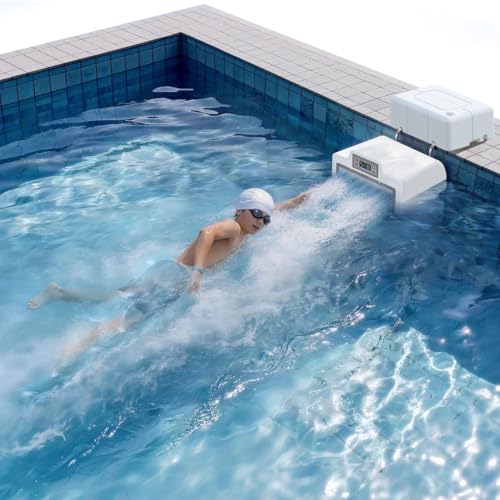
ECOROOLTECH Swim Current Machine for In-Ground Pools, Safe 30V Low Voltage StationarySwimming Trainer, 9-Speed Adjustable Water Flow Swim Jet for Beginner Training, LeisureSwimming & Family Fun, R100
𝐄𝐍𝐃𝐋𝐄𝐒𝐒 𝐒𝐖𝐈𝐌𝐌𝐈𝐍𝐆 𝐀𝐓 𝐇𝐎𝐌𝐄-Transform your in-ground pool into a personal swim training space. The high-efficiency brushless motor generates…
As an affiliate, we earn on qualifying purchases.
As an affiliate, we earn on qualifying purchases.
Conclusion
Choosing between tethered swimming and powered currents is like picking between a steady compass and a gusty wind—you need to find what guides your training best. Tethered swimming offers control and focus, while powered currents provide a dynamic, flowing experience. Both are valuable tools in your fitness journey, each adding its unique flavor to your workout. Ultimately, your choice shapes your progress, turning your pool into a personalized ocean of opportunity.

Hikeen Swimming Training Belt 4M Swimming Tether Swim in Place Harness Stationary Aquatic Resistance Belt
Designed for stationary swimming in home & lap pools with adjustable bungee cord for resistance training
As an affiliate, we earn on qualifying purchases.
As an affiliate, we earn on qualifying purchases.
Swimming Pool Current Generator – Swim Wave Maker Machine for Inground Pools, High Flow Constant Machine for Swimming Training/Fitness/Relaxation, 110V/60Hz
Personal Swim Lane: Turn your small pool into a real swimming pool. Most above ground pools, due to…
As an affiliate, we earn on qualifying purchases.
As an affiliate, we earn on qualifying purchases.