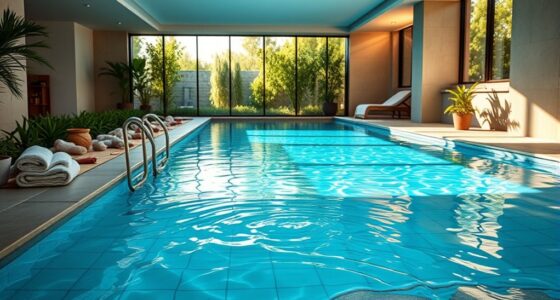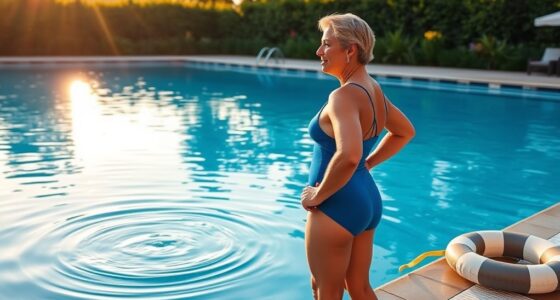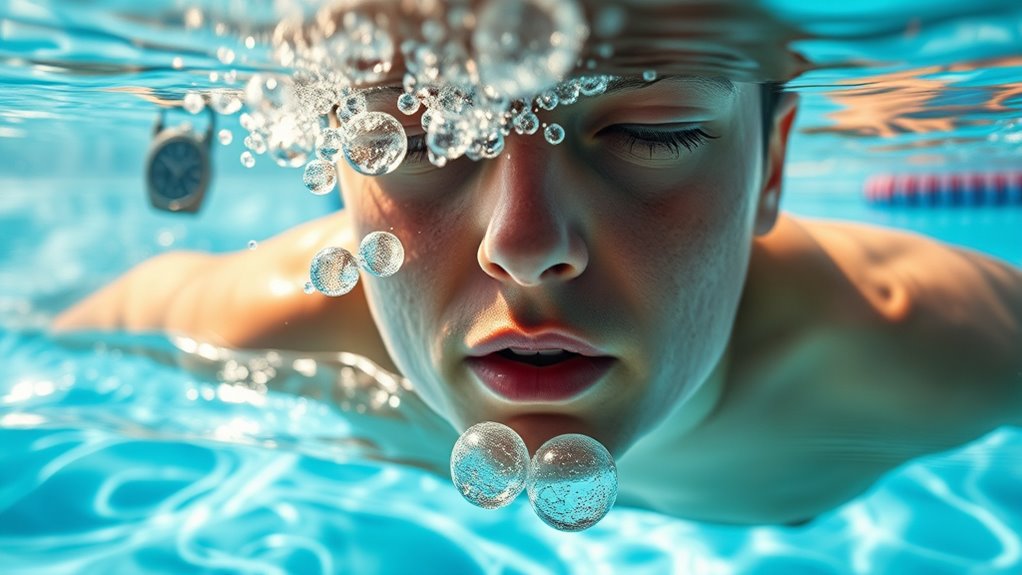

To improve your breath control and CO₂ tolerance with pool drills, focus on specific exercises that build lung capacity and mental resilience. These include controlled inhalations, extended breath-holds, and gradual increases in holding times. The pool environment offers a safe, controlled setting to push your limits while minimizing risks. By consistently practicing these drills, you’ll enhance your endurance, mental focus, and ability to handle higher CO₂ levels. Keep going to discover more effective techniques.
Key Takeaways
- Pool drills safely enhance breath control and CO₂ tolerance through controlled inhalation, breath-holds, and gradual progression.
- They help expand lung capacity, allowing for longer, more efficient breaths during physical and mental activities.
- Structured exercises train the body to adapt to higher CO₂ levels, increasing tolerance and reducing the urge to breathe.
- The pool environment offers a safe, controlled setting for focused practice and steady improvement of breath-hold times.
- Techniques from sports and physical training accelerate progress, improve calmness under stress, and boost overall respiratory resilience.
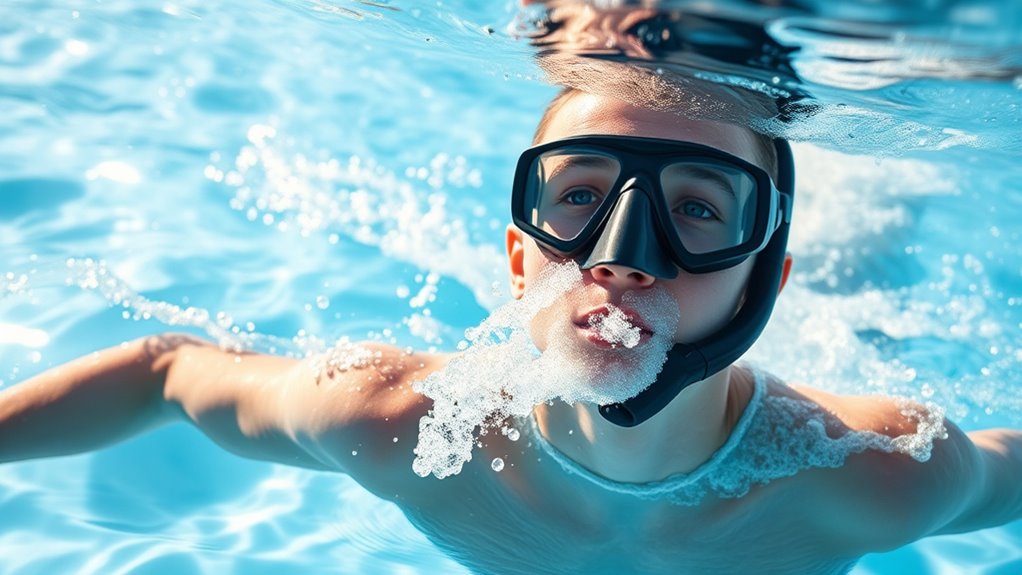
Mastering breath control and increasing your CO₂ tolerance can considerably improve your overall respiratory efficiency and mental clarity. When you focus on expanding your lung capacity through specific pool drills, you enable your body to utilize oxygen more effectively. This isn’t just about taking deeper breaths; it’s about training your lungs to handle greater volumes of air over time, which translates into better endurance and reduced fatigue during physical activity. As your lung capacity grows, you’ll notice that you can sustain longer periods of breath-holding and perform more demanding exercises with less effort. This enhanced capacity also contributes directly to improved mental focus, as a well-oxygenated brain functions more sharply and reacts more swiftly. Incorporating breath training techniques that are used in sports and physical training can further accelerate your progress and effectiveness. In the pool, you have a controlled environment where you can safely push your limits without the risks associated with outdoor or open water. Pool drills designed for breath control often involve breath-hold exercises that are structured to gradually increase your tolerance for CO₂. For example, you might start with controlled inhalations, holding your breath for a set period, then gradually extend that time as your comfort level improves. These drills help you become more aware of your breathing patterns and teach your body to tolerate higher levels of carbon dioxide, which naturally accumulates when you hold your breath. Over time, this adaptation not only boosts lung capacity but also helps you stay calm and focused under stress, both physically and mentally.

INTEX 2,650 GPH Krystal Clear Sand Filter Pump and Saltwater Pool Chlorine System for Above Ground Pools, Pool Cleaner System with Automatic Timer
✔ FRESH AND CLEAN WATER – QX2600 uses sand for excellent filtration combined with the QS1200 saltwater system...
As an affiliate, we earn on qualifying purchases.
Frequently Asked Questions
How Long Should I Hold My Breath During Drills?
You should aim for a breath hold duration that challenges your hypercapnia adaptation without causing discomfort or panic. Start with comfortable holds, gradually increasing as your CO₂ tolerance improves. Typically, holding your breath for 30 to 60 seconds is effective, but listen to your body. Focus on controlled breathing and relaxation, and avoid pushing beyond your limits to safely enhance your breath control and hypercapnia adaptation over time.
Can These Drills Improve My Overall Swimming Endurance?
These drills can boost your swimming endurance more than you’d believe. By practicing breath control and CO₂ tolerance, you’ll refine your technique and build mental resilience. As you push your limits, your stamina improves, allowing you to swim longer without fatigue. Consistent training with these exercises strengthens your lungs and mental toughness, making you a more efficient and enduring swimmer. Keep at it, and you’ll notice your overall endurance skyrocket.
Are There Risks Associated With Breath-Hold Training?
Yes, there are risks associated with breath-hold training. You should always follow safety precautions, such as never practicing alone, avoiding hyperventilation, and listening to your body. Health concerns like shallow water blackout or hypoxia can occur if you push too hard or ignore signs of distress. Always start slowly, stay within your limits, and consult a professional if you’re unsure about your safety.
How Often Should I Perform Co₂ Tolerance Exercises?
You should perform CO₂ tolerance exercises 3-4 times a week, allowing your body time to adapt without risking overtraining. Follow the frequency recommendations from experienced trainers or guidelines and always track your progress to see improvements safely. Pay attention to how your body responds, and if you experience discomfort or dizziness, reduce the frequency or intensity. Consistency and gradual progression are key to building tolerance safely.
Do These Drills Work for Beginner or Only Advanced Swimmers?
These drills are great for both beginners and advanced swimmers, as about 60% of athletes find they can adapt their technique over time. As a beginner, you should prioritize safety and gradually build your CO₂ tolerance with simple exercises. With consistent practice, you’ll notice improved breath control and comfort underwater. Just remember, proper technique adaptation is key to avoiding discomfort or overexertion, especially when starting out.

XtremepowerUS 24" Sand Filter Inground Ground Above Ground System Swimming Pool 29,400 Gallons
The Filter are perfectly engineered to provide optimum flow rates that promotes clean water quality
As an affiliate, we earn on qualifying purchases.
Conclusion
By practicing these pool drills, you’ll gradually build your breath control and CO₂ tolerance, making you more comfortable underwater. Imagine yourself in a competition, calmly holding your breath longer than before, even as your heart races. Like Sarah, who started with just a few seconds and now effortlessly stays submerged for over a minute. Consistency and patience are key—soon, you’ll find yourself more confident and in control during every breath-hold.

Pool Lights for Inground Pool, 60W 10 Inch LED Inground Pool Light with Controller, Remote and APP Control for Wet Niche, Color Changing Underwater Swimming Pool Lights with 50 Foot Cord
【3 Ways to Control: APP + Controller + Remote】Traditional led pool lights often suffer from signal loss due...
As an affiliate, we earn on qualifying purchases.

SWIMLINE HYDROTOOLS Complete Sand Filter System, 14" Tank - for Above-Ground & Inground Pools Up to 10,500 Gallons, Single Speed Pump, 0.45 THP, 2,400 GPH, 4-Way Multi-Port Valve, 60 lb Capacity
Optimized Filtration: Swim in crystal-clear pool waters with Swimline HydroTools sand filters, designed for optimized filtration efficiency and...
As an affiliate, we earn on qualifying purchases.