Get pool and patio gear delivered free — and shop member deals
- Fast, free delivery on millions of items
- Access to Prime Big Deal Days deals on October 6–7
- Prime Video, Amazon Music and more included
Robotic vs. Suction-Side Pool Cleaners: The Real Decision
When pool owners start shopping for an automatic cleaner, the comparison almost always comes down to two families of products: robotic cleaners (self-contained units with their own motors and filters, like Dolphin models) and suction-side cleaners (hose-based crawlers such as the Kreepy Krauly or Zodiac Barracuda that attach to your skimmer or a dedicated suction line). The price gap between them is dramatic — a good suction cleaner runs $150 to $400, while a quality robot costs $500 to $1,200 or more — and that gap forces the real question: is the robot worth three to five times the price?

Hydro 3 Cordless Robotic Pool Vacuum for Above Ground Pools
- ✔ Battery Capacity: 11000mAh
- ✔ Max Runtime: 200 minutes
- ✔ Max Pool Coverage: 861–1076 sq.ft

CZYBYTE Cordless Robotic Pool Vacuum Cleaner with App Support, Orange
- ✔ Suction Power: Up to 4500 GPH
- ✔ Debris Basket Capacity: 4L
- ✔ Filter Mesh: 150μm
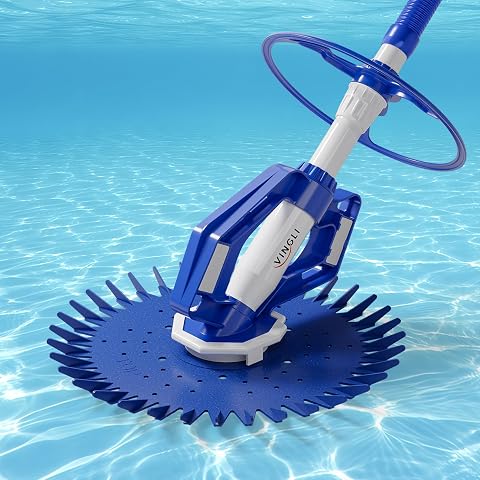
VINGLI Automatic Wall-Climbing Pool Vacuum Cleaner with 33FT Hoses (Navy Blue & White)
- ✔ Power Source: Suction powered (filtration system)
- ✔ Minimum Pump Requirement: 3/4 HP (or 1600 GPH)
- ✔ Hose Length: 33 ft (ten 3.3FT sections)
The answer depends on what you hate most about pool ownership. If your frustration is spending twenty minutes a day brushing and vacuuming by hand, a suction cleaner solves most of that for very little money. If your frustration is algae on the walls, fine silt that never seems to get captured, or a pump that runs long hours just to keep the floor clear, a robot is the better tool — it scrubs walls and waterlines, filters water independently of your circulation system, and cuts pump runtime.
This guide compares the two side by side across cleaning performance, total cost, energy use, maintenance burden, wall and waterline coverage, debris handling, and expected lifespan, then matches each option to the type of pool owner it actually fits.
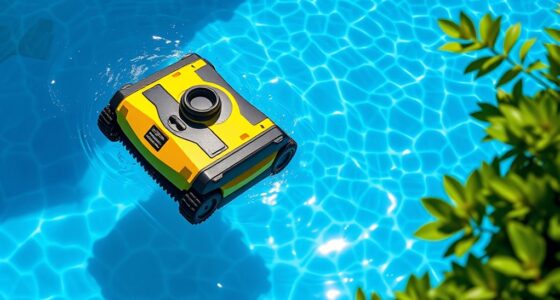
Hydro 3 Cordless Robotic Pool Vacuum for Above Ground Pools
The Hydro 3 takes our top spot because it solves the two problems that most frustrate cordless robot owners: short battery life and dirty waterlines. With an 11000mAh battery rated for up to 200 minutes, this model can clean a large above-ground pool — up to 861–1076 sq.ft — in a single session where competitors often need a recharge mid-cycle. That translates directly into less babysitting: you drop it in, and it finishes the job.Its 5070 GPH dual brushless motor suction is the strongest in this lineup, edging out the CZYBYTE by a meaningful margin, which matters most for heavier debris loads like leaves and sand. The patented waterline translation technology is the real differentiator, though — it holds the unit stable at the waterline where sunscreen film and floating debris collect, something the VINGLI can reach but far less consistently, and the CZYBYTE handles without the same stabilization focus. The 4.1L filter basket with 180μm nylon filtration is also the largest here, meaning fewer mid-season basket swaps during heavy leaf fall.The honest tradeoff: real-world runtime typically lands below the 200-minute maximum depending on pool size, debris load, and how much wall-climbing the unit does. Compared with the CZYBYTE, you also give up app control and dedicated cleaning modes — the Hydro 3 is more of a set-it-and-forget-it workhorse than a tunable tool. If you want route planning, look one pick down.
Pros:
- Long 200-minute cordless runtime covers large pools in one session
- Powerful 5070 GPH dual brushless motor suction handles leaves and sand
- Patented waterline translation cleans the ring most robots skip
- Large 4.1L basket with 180μm filtration reduces emptying frequency
Cons:
- Real-world runtime often falls short of the advertised maximum
- No app support or selectable cleaning modes
Best for: Owners of medium-to-large above-ground pools who want maximum runtime and complete floor-to-waterline cleaning without managing hoses or a pump
Not ideal for: Buyers who want app control, selectable cleaning modes, or the finest possible filtration for silty water
Bottom line: The most complete cordless package here — longest runtime, strongest suction, and true waterline cleaning for large above-ground pools.
“The most complete cordless package here — longest runtime, strongest suction, and true waterline cleaning for large above-ground pools.”
CZYBYTE Cordless Robotic Pool Vacuum Cleaner with App Support, Orange
Where the Hydro 3 brute-forces its way through cleaning with raw suction and endurance, the CZYBYTE takes a smarter approach. Its intelligent S-shaped navigation works like a mowing pattern, systematically sweeping the floor instead of wandering randomly — the difference between a clean that finishes in one pass and one that leaves streaks you have to re-run. Add three cleaning modes and app support, and you get a level of control the Hydro 3 simply doesn’t offer.Its 4500 GPH brushless suction sits slightly below the Hydro 3’s output, but in practice the efficient routing compensates: less wasted movement means more of that suction goes onto actual dirty surface. The 4L top-loading debris basket with 150μm mesh is actually the finest filtration in this lineup, catching silt and fine particles the Hydro 3’s 180μm filter lets pass — a genuine advantage for pools that collect dust or pollen film. Unlike the VINGLI, it works in both inground and above-ground pools, and its automatic parking behavior — surfacing when the cycle ends or the battery runs low — makes retrieval painless.The friction points are real but manageable. The app transition requires uninstalling an older version before the updated one works, which has confused existing users, and you must remember to manually seat the charging port plug before every submersion or risk water intrusion. Compared with the Hydro 3’s plug-in simplicity, the CZYBYTE asks slightly more of you — in exchange for a cleaner that thinks while it cleans.
Pros:
- S-shaped intelligent navigation delivers systematic, streak-free floor coverage
- Three cleaning modes plus app support let you tailor each cycle
- Finest filtration here (150μm) captures silt and fine particles
- Automatically parks above the waterline when finished or low on battery
Cons:
- App requires uninstalling the old version before the update works
- Charging port plug must be manually secured before every submersion
- Slightly less raw suction than the Hydro 3
Best for: Pool owners who want programmable, navigation-guided cleaning and the finest filtration for silty or pollen-prone water
Not ideal for: Set-and-forget buyers who never want to touch an app, or anyone likely to forget the charging-plug ritual
Bottom line: The smartest cleaner of the three — ideal if you value route planning and fine filtration over maximum runtime.
“The smartest cleaner of the three — ideal if you value route planning and fine filtration over maximum runtime.”
VINGLI Automatic Wall-Climbing Pool Vacuum Cleaner with 33FT Hoses (Navy Blue & White)
The VINGLI represents the old-school approach: no batteries, no apps, no charging ports to babysit. It attaches to your existing filtration system via 33 feet of included hose and lets your pool pump do the work. That simplicity is its superpower — there’s nothing to recharge, no runtime limit, and no firmware quirks like the CZYBYTE’s app reinstall. If your pool pump is running anyway, the VINGLI is essentially free to operate.Its wall-climbing capability puts it ahead of typical budget suction cleaners, and the adjustable suction and wheel deflector help it navigate corners without jamming — a common failure point in this category. Operation is notably quieter than most automatic cleaners, and the 3-minute assembly is genuinely tool-free. Against the Hydro 3, it gives up waterline cleaning and cordless freedom entirely; against the CZYBYTE, it loses above-ground compatibility. But for debris, it feeds everything straight into your filter system, so there’s no basket to empty at all — a chore both robots impose after every cycle.The constraints are structural. It requires a minimum 3/4 HP pump (or 1600 GPH flow) — underpowered pumps leave it crawling weakly or stuck — and it’s inground-only, full stop. Debris also loads your filter rather than a basket, so you’ll backwash more often with heavy leaf fall. Within this three-way comparison, the VINGLI is the value play: less capable in absolute terms, but far cheaper to buy and run, provided your setup meets its pump requirement.
Pros:
- Runs off your existing pump — no charging, no runtime limit
- Wall-climbing with adjustable suction and anti-jam wheel deflector
- 33FT of durable, scuff-resistant hose included
- Quiet operation and 3-minute tool-free assembly
Cons:
- Requires a minimum 3/4 HP pump (or 1600 GPH) to function properly
- Inground pools only — no above-ground compatibility
- Debris loads your pool filter, increasing backwashing frequency
Best for: Inground pool owners with a 3/4 HP or larger pump who want dependable, always-ready cleaning at the lowest cost
Not ideal for: Above-ground pool owners or anyone whose pump falls below the 3/4 HP / 1600 GPH minimum
Bottom line: The cheapest path to automatic cleaning for properly equipped inground pools — simple, quiet, and dependable, as long as your pump can drive it.
“The cheapest path to automatic cleaning for properly equipped inground pools — simple, quiet, and dependable, as long as your pump can drive it.”
As an Amazon Associate we earn from qualifying purchases.
At a Glance
| Criteria | Robotic pool cleaners | Suction-side automatic pool cleaners | Winner |
|---|---|---|---|
| Upfront cost | $500–$1,200+ | $150–$400 | B |
| Floor cleaning performance | Excellent, with active scrubbing | Good on floors, random pattern | A |
| Wall and waterline cleaning | Excellent on most models | Poor to none (most models) | A |
| Fine debris filtration | Excellent — own fine-filter cartridge | Poor — debris goes to pool filter | A |
| Energy use | Very low (5–10x cheaper per cycle than pump) | High indirectly — requires long pump runtimes | A |
| Impact on filtration system | None — fully independent | High — occupies skimmer, loads filter | A |
| Maintenance and repairs | Moderate — cartridges, drive tracks, occasional repairs | Low — few moving parts, cheap diaphragms | B |
| Expected lifespan | 5–7 years with care | 10+ years for simple models | B |
Key Differences
Key Differences That Matter
The single biggest functional difference is independence. A robotic cleaner is a complete, self-contained system: it has its own drive motors, its own pump, and its own filter, so it cleans whether or not your pool equipment is running. A suction-side cleaner is a parasite on your circulation system — it only works when the pool pump is on, it occupies your skimmer (or a dedicated line), and everything it picks up ends up in your pool filter, forcing more frequent backwashing and filter cleaning. In practice, this means a robot owner can run a two-hour cleaning cycle and shut everything down, while a suction owner often needs six to eight hours of pump runtime to get similar floor coverage — which quietly erodes the suction cleaner’s cost advantage through higher electricity bills.
The second major difference is scrubbing versus sucking. Robots have active brush rollers that physically scrub floors, walls, and (on most mid-range and premium models) the waterline, which is where algae and biofilm actually establish themselves. Suction cleaners simply pull water through a throat or diaphragm; they lift loose debris but do nothing to attached algae or grime, so you still need to brush walls by hand. If your pool grows algae on vertical surfaces, no suction cleaner solves that problem — a robot with wall-climbing capability does, at least partially.
The third difference cuts the other way: simplicity and durability. A suction cleaner is a handful of plastic parts with one wearable component (usually a diaphragm or flapper that costs $15–$30 to replace every year or two). Simple models like the Kreepy Krauly routinely last a decade or more. Robots have motors, electronics, tracks, and power supplies that cost real money to repair out of warranty, and most last five to seven years before something expensive fails. The suction cleaner is the machine you never think about; the robot is the machine you think about every time it needs a repair.
Detailed Comparison
Upfront cost (Suction-side automatic pool cleaners wins — major)
Suction-side cleaners win this by a wide margin. A competent unit like the Zodiac MX8 or a basic Kreepy Krauly costs $150–$400, while effective robots start around $500 and the models that climb walls and scrub waterlines well run $700–$1,100. The gap is real money — enough to buy years of chemicals. However, the sticker gap shrinks once you factor in energy: running a pool pump an extra 4–6 hours daily to power a suction cleaner can add $30–$80 per month in electricity, while a robot draws roughly 180 watts and costs pennies per cycle. Over three to five seasons, the total-cost gap narrows considerably, especially in high-electricity-rate areas.
Floor cleaning performance (Robotic pool cleaners wins — moderate)
Both types clean pool floors adequately, but differently. Robots use mapped or smart-nav patterns and cover the floor systematically, and their brush rollers agitate stuck-on debris that a suction cleaner leaves behind. Suction cleaners follow random or fixed patterns — they eventually cover the floor, but coverage is statistical rather than deliberate, and corners and steps are often missed or poorly handled. For a typical leaf-and-dust load, the practical difference is moderate: both leave a clean floor eventually. For heavy debris loads or fine dirt, the robot pulls ahead clearly.
Wall and waterline cleaning (Robotic pool cleaners wins — major)
This is where the two categories genuinely diverge. Most mid-range and premium robots climb walls and scrub the waterline tile line, removing the scum ring and early algae that hand-brushing usually handles. Nearly all suction-side cleaners either cannot climb walls at all or do so poorly, and none scrub — they only suction. If your pool’s vertical surfaces get dirty, a suction cleaner changes nothing about your brushing routine, which quietly undercuts the ‘automatic’ promise. Winner: robot, and the gap is major if algae is your issue.
Fine debris and filtration (Robotic pool cleaners wins — moderate)
Robots capture everything they pick up in their own filter cartridges or bags, including fine silt and even some pollen, and many models filter down to 20 microns — effectively polishing the water. Suction cleaners send all debris to your pool’s filter and skimmer basket, meaning fine particles pass through or load the filter faster, increasing backwashing frequency. If your pool collects dust, pollen, or fine sand, the robot’s difference in water clarity is visible within weeks.
Energy use and system impact (Robotic pool cleaners wins — moderate)
A robot consumes roughly 180 watts for a 1–2 hour cycle — about 5 cents per run. A suction cleaner requires your pool pump (often 1–2 HP, or even more on single-speed pumps) to run for many hours, costing far more per day and tying your cleaning schedule to pump schedules. Additionally, because the suction cleaner occupies the skimmer, surface skimming suffers while it runs, and the pool filter works harder. In warm climates with long pump seasons, the robot’s energy advantage alone can justify a meaningful part of its price premium.
Maintenance and repairs (Suction-side automatic pool cleaners wins — moderate)
Suction cleaners are mechanically simple. Their common failure — a torn diaphragm or worn foot pad — costs $15–$50 and takes ten minutes to replace, and hoses wear out slowly. Robots need cartridge rinsing after most cycles, and out-of-warranty repairs (power supplies, drive motors, control boards) can cost $150–$400, sometimes approaching the price of a new budget unit. If you want a fit-it-and-forget-it device, suction wins; if you don’t mind occasional rinsing and repair decisions, the robot’s burden is manageable but real.
Expected lifespan (Suction-side automatic pool cleaners wins — moderate)
Simple suction cleaners are famously long-lived — many Kreepy Krauly units run 10–15 years with only diaphragm replacements. Robots typically last 5–7 years before a major component fails, and technology turnover makes replacement parts scarcer over time. On a per-year basis, the lifecycle costs are closer than the sticker prices suggest, but the suction cleaner still holds a durability edge.
Ease of daily use (minor difference)
Both are ‘drop it in and let it work’ devices, but with different rituals. The robot: carry it to the pool (they weigh 20–40 lbs), drop it in, press start or let a schedule run it, then pull it out and rinse the cartridge. The suction cleaner: attach hoses, connect to the skimmer, confirm flow — and leave it in the pool permanently, which many owners prefer because there is nothing to haul. People who dislike lifting and handling equipment often prefer the always-installed suction cleaner; people who dislike hoses cluttering the pool prefer the robot that gets put away.
Robotic pool cleaners: Pros and Cons
Pros:
- Cleans independently of the pool pump and filter system
- Scrubs floors, walls, and waterline on most models
- Filters fine debris down to ~20 microns, improving water clarity
- Very cheap to run — pennies per cleaning cycle
- Programmable cycles, timers, and some models have apps
- Reduces required pump runtime, lowering electric bills
Cons:
- High upfront cost ($500–$1,200+)
- Heavy to lift in and out of the pool
- Cartridge needs rinsing after most cycles
- Out-of-warranty repairs can be expensive
- Typical lifespan of 5–7 years before major failure
Suction-side automatic pool cleaners: Pros and Cons
Pros:
- Very low upfront cost ($150–$400)
- Extremely simple mechanically; DIY repairs cost $15–$50
- Can stay in the pool permanently — nothing to haul
- Proven simple designs last 10+ years
- No electronics, power supplies, or software to fail
Cons:
- Only works while the pool pump runs — long runtimes needed
- Occupies the skimmer, reducing surface skimming
- Dumps all debris into the pool filter, increasing backwashing
- Little to no wall or waterline cleaning, and no scrubbing action
- Random coverage misses corners and steps; hoses can tangle
Who Should Choose What
Choose Robotic pool cleaners if:
- You get algae or scum on walls and the waterline and want less hand-brushing
- Your pool collects fine silt, pollen, or dust that your current setup never fully captures
- You want to cut pool pump runtime and lower electricity bills
- You have a large pool where random-pattern suction coverage is too slow or incomplete
- You have the budget and don’t mind rinsing a filter cartridge after each cycle
Choose Suction-side automatic pool cleaners if:
- You want the cheapest effective way to stop manual vacuuming of the floor
- Your pump already runs long hours anyway (e.g., for a salt system or heating)
- You have a dedicated suction line so the skimmer stays free
- You want a set-and-forget device that lives in the pool with near-zero attention
- Your debris load is mostly leaves and coarse material on the floor
Skip both if: Your pool is surrounded by heavy trees that drop large volumes of leaves — a pressure-side cleaner with a dedicated debris bag, or a leaf-catcher setup, handles big leaves better than either of these. Also skip both if your pool is tiny and takes ten minutes to vacuum by hand; no automation pays for itself there.
Value for Money
Is the Robot Worth the Extra Money?
On sticker price alone, the suction cleaner is the obvious value pick — it does the core job (clean floor, less manual vacuuming) for a third of the cost or less. But value should be measured against what you actually buy. If you only need floor debris removal and your pump runs anyway, the suction cleaner is better value, full stop; paying $800 for a robot would buy capability you will not use.
The robot justifies its premium when it replaces labor and energy you would otherwise pay for. If it scrubs walls you currently brush by hand twice a week, filters fine debris your filter struggles with, and lets you cut pump runtime by several hours a day, the premium pays back over three to five seasons in electricity and chemical savings alone — before counting your time. In high-rate electricity areas with long seasons (Florida, Arizona, Texas, Australia), the economics favor the robot clearly. In short-season climates with variable-speed pumps already running efficiently, the payback is slower and the suction cleaner remains the smarter buy.
The honest framing: the suction cleaner is the better value per dollar; the robot is the better product per task. Decide which currency matters more to you.
Final Verdict
Choose a robotic cleaner if cleaning quality matters more than cost. For pool owners who fight algae on walls, deal with fine debris, want visibly clearer water, or simply want the most thorough automation available, the robot is worth the premium and is the better machine — it cleans more surfaces, more thoroughly, and more cheaply per cycle. If your budget allows $600–$1,000, buy the robot and skip the intermediate step; most owners who buy a cheap suction cleaner first and fight algae end up buying the robot within two seasons anyway.
Choose a suction-side cleaner if your needs are simple and your budget is real. If your problem is leaves and dust on the floor, your pump runs long hours regardless, and you want a durable device that costs almost nothing to own and repair, a $200–$400 suction cleaner is a rational, excellent purchase — not a compromise. It will run for a decade on $30 diaphragms.
The deciding factor is almost always walls and waterline: if you need vertical surfaces cleaned automatically, only the robot does it. If floor-only coverage is enough, the suction cleaner wins on value and simplicity. For most pool owners with a $700+ budget and a real algae or clarity problem, the robotic cleaner is the stronger recommendation; for everyone else, the suction-side cleaner is the smart, frugal default.
Frequently Asked Questions
Can a suction-side cleaner climb pool walls?
Most cannot, and even the few models marketed with wall-climbing ability do it inconsistently and only suction — they never scrub. If wall and waterline cleaning matters to you, a robotic cleaner is the only automatic option that handles it properly.
Do robotic cleaners really save money on electricity?
Yes, indirectly. A robot draws about 180 watts for a 1–2 hour cycle and works independently of your pump, so you can shorten pump runtime by several hours a day. Depending on your pump size and local electricity rates, that typically saves $20–$80 per month during the season — a meaningful offset against the robot’s higher purchase price.
Which type lasts longer?
Simple suction cleaners, often 10–15 years, because they contain almost nothing that can fail beyond a cheap diaphragm. Robots typically last 5–7 years before a motor, board, or power supply fails, and major repairs out of warranty can approach the cost of a new budget unit.
Can I just leave either cleaner in the pool all the time?
Suction cleaners are designed to stay in the pool permanently, and most owners do. Robots should be removed after each cycle: constant immersion degrades the cable, tracks, and seals faster, and most manufacturers recommend storing the robot out of the water between cleanings.
Is a cheap $150 suction cleaner actually good enough?
For floor debris on a small to medium pool with a decent pump, yes — models like the basic Kreepy Krauly or Hayward models have cleaned pools reliably for decades. They become disappointing when expectations expand to walls, fine silt, corners, or low pump runtime, which is exactly where robots earn their price.
Fall Picks
fall essentials
As an affiliate, we earn on qualifying purchases.