
TL;DR

Get pool and patio gear delivered free — and shop member deals
- Fast, free delivery on millions of items
- Access to Prime Big Deal Days deals on October 6–7
- Prime Video, Amazon Music and more included
A new foam-based floating solar PV system with air bubblers has been developed to enhance energy yield and prevent ice in cold climates. Initial experiments show promising efficiency and economic viability, but wider adoption remains uncertain.
Researchers at Western University have developed and tested a foam-backed floating solar PV system equipped with air bubblers, aiming to improve energy efficiency and ice prevention in cold climates. This innovation could expand floating solar’s viability in regions previously considered challenging for such installations, marking a significant step forward in sustainable energy technology.
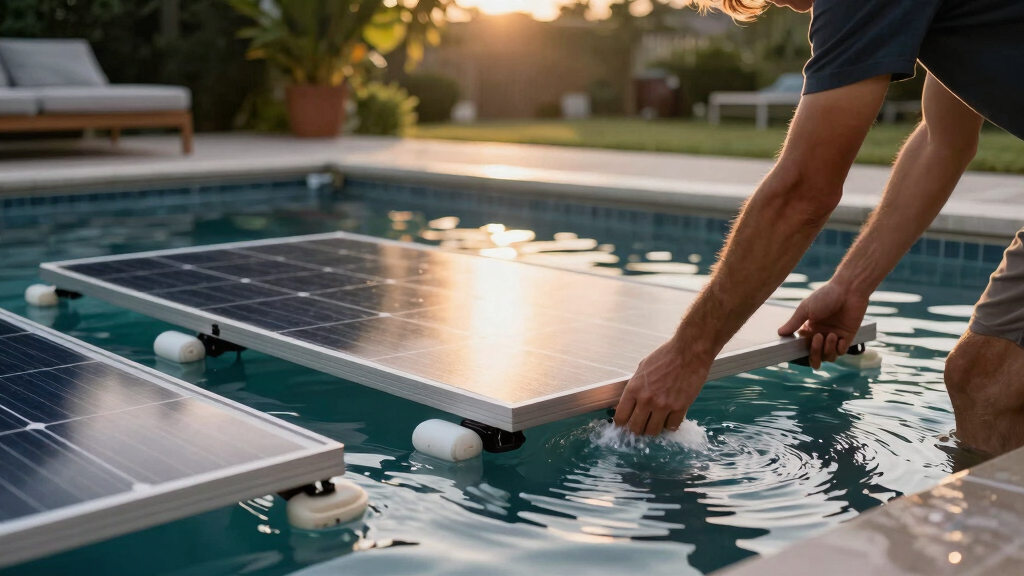
The foam-based floating PV system uses polyethylene foam slabs to support solar modules, floating approximately 1 centimeter above water. An integrated air bubbler system is employed to prevent ice formation during cold conditions, with experimental setups showing that this approach reduces ice buildup and maintains system operation.
Initial studies, published by Western University, indicate that the foam-backed design yields higher annual energy production compared to traditional floating PV models, especially in colder environments. The system also demonstrated water evaporation reduction, contributing to water conservation efforts. Experts involved in the research emphasize the system’s economic potential and its adaptability to cold regions, where conventional floating solar faces limitations due to ice and low temperatures.
Potential Impact of Foam-Based PV with Air Bubblers in Cold Regions
This development could significantly expand the deployment of floating solar in colder climates, where ice formation and low temperatures hinder traditional systems. The foam-backed design offers improved insulation, potentially increasing energy yield and operational reliability. If scalable, this technology might open new markets for floating solar, contributing to global renewable energy targets and water conservation efforts.
As an affiliate, we earn on qualifying purchases.
Floating Solar Innovation and Cold Climate Challenges
Floating solar PV has grown rapidly worldwide, with over 10 GW installed by 2025. However, cold climates pose unique challenges, including ice formation and temperature-related efficiency losses. Previous innovations focused on warmer regions, leaving cold environments underexplored. Recent research by Western University introduces foam-backed floating PV systems with air bubblers, aiming to address these issues and improve performance in such conditions.
“The foam-based FPV generated more energy annually compared to other PV models, emphasizing the importance of accurate temperature modeling for cold-climate systems.”
— an anonymous researcher
Uncertainties Surrounding Large-Scale Implementation
While laboratory and small-scale experiments show promising results, it remains unclear how well the foam-backed floating PV system with air bubblers will perform at commercial scale and across diverse water bodies. Further testing is needed to assess long-term durability, cost-effectiveness, and operational reliability in real-world cold environments.
Next Steps for Commercial Viability and Scaling
Researchers plan to conduct larger-scale field trials to evaluate the system’s performance over multiple seasons and in different geographic locations. Industry stakeholders will monitor these developments to determine potential for commercial deployment. Regulatory and economic analyses will also be essential to establish feasibility and market adoption pathways.
Key Questions
How does the foam-backed floating PV system improve efficiency in cold climates?
The foam provides insulation, reducing heat loss and maintaining higher operating temperatures for the solar panels, while the air bubblers prevent ice formation that can damage or impair system performance.
Are air bubblers energy-intensive or costly to operate?
According to the research, the air bubbler system uses minimal energy and is designed to be cost-effective, making it a practical solution for cold-climate floating PV installations.
Can this foam-based system be deployed in large-scale commercial projects?
While initial results are promising, further testing at larger scales is needed to confirm economic viability and operational durability before commercial deployment can be considered.
What are the main challenges remaining for this technology?
Key challenges include scaling the system, ensuring long-term durability in harsh weather conditions, and evaluating overall cost-effectiveness compared to existing solutions.
Will this technology work in all cold climates worldwide?
Further research is required to determine adaptability across diverse water bodies and climatic conditions, as local factors may influence performance.
Source: CleanTechnica
Fall Picks
fall essentials
As an affiliate, we earn on qualifying purchases.