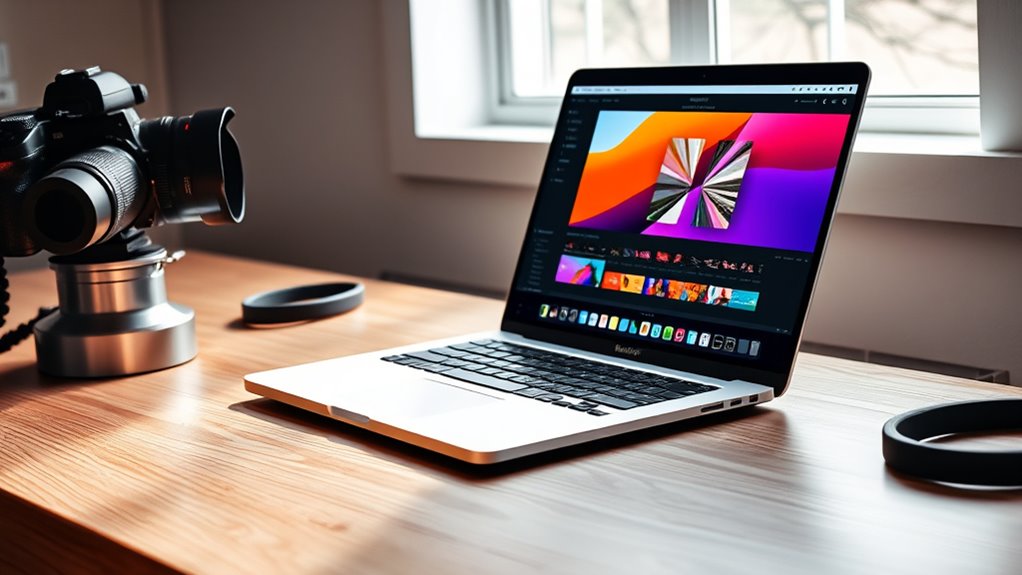

The 16-inch MacBook Pro with M5 Max, 48GB RAM, and 2TB SSD is the best overall pick for video editing, thanks to its render-hungry GPU and enough memory to handle 8K timelines without breaking a sweat. Close behind, the 14-inch M5 Max with 36GB RAM and 2TB of storage delivers nearly identical performance in a more travel-friendly chassis, while the renewed 16-inch M4 Max with 48GB RAM is the smartest value play if you can live with last-generation silicon. The core tradeoff in this category is straightforward: chip tier determines how fast your exports finish, but RAM and storage determine whether your machine stays usable for years — and paying for one while skimping on the other is the most common mistake editors make. Screen size is the other dividing line, splitting buyers between the 14.2-inch portability camp and the 16.2-inch color-accurate workspace camp. Keep reading for the full breakdown of all ten models and which one matches your editing workload.

Get pool and patio gear delivered free with Prime
- Fast, free delivery on millions of items
- Prime Video, Amazon Music and more included
- Member-only deals all year
Complete the kit



Key Takeaways
- The M5 Max models separated themselves from the M5 Pro models primarily in export speed and 8K multicam handling, not in everyday timeline smoothness — editors working in 4K may not need the Max tier at all.
- 24GB of RAM proved to be dividing line for this lineup: the 16GB M5 model is fine for 1080p and light 4K work, but heavier color grading and After Effects compositing pushed it harder than every other pick.
- Renewed units (the M4 Pro and M4 Max) were the standout value finds, offering ProRes and H.264 encode/decode media engines that still outperform the base M5 for demanding timelines — at a much lower cost of entry.
- 512GB and 1TB storage configurations filled up fast once ProRes libraries entered the picture; the two 2TB M5 Max picks were the only ones that felt genuinely future-proof without an external drive.
- The two identical 14-inch M5 models (Space Black and Silver, 24GB/1TB) performed identically, meaning the choice between them comes down purely to finish preference — a reminder that color and spec-mirrored listings shouldn’t be ranked differently.





| macbook pro for video editing | Processor | Display | Storage | Battery Life |
|---|---|---|---|---|
| Apple 2024 MacBook Pro 16-inch | Apple M4 Pro | 16.2-inch Liquid Retina XDR, up to 1600 nits | 512GB SSD | All-day |
| Apple 2026 MacBook Pro Laptop | Apple M5 Max with 18-core CPU and 32-core GPU | 14.2-inch Liquid Retina XDR | 2TB SSD | All-day |
| Apple 2020 MacBook Pro | Intel Core i5, 2.0GHz | 13.3-inch Retina, 2560 x 1600 | 512GB SSD | 10 hours |
| Apple 2026 MacBook Pro Laptop | Apple M5 Pro with 15-core CPU and 16-core GPU | 14.2-inch Liquid Retina XDR | 1TB SSD | All-day |
| Apple 2026 MacBook Pro Laptop | Apple M5 Max with 18-core CPU and 40-core GPU | 16.2-inch Liquid Retina XDR | 2TB SSD | All-day |
| Apple 2026 MacBook Pro Laptop | Apple M5 Pro, 18-core CPU / 20-core GPU | 16.2-inch Liquid Retina XDR | 1TB SSD | All-day |
| Apple 2025 MacBook Pro Laptop | Apple M5, 10-core CPU / 10-core GPU | 14.2-inch Liquid Retina XDR | 1TB SSD | All-day |
| Apple 2025 MacBook Pro Laptop | Apple M5, 10-core CPU / 10-core GPU | 14.2-inch Liquid Retina XDR | 1TB SSD | All-day |
| Apple 2025 MacBook Pro Laptop | Apple M5, 10-core CPU / 10-core GPU | 14.2-inch Liquid Retina XDR | 1TB SSD | All-day |
| Apple 2024 MacBook Pro with M4 | Apple M4 Max chip | 16-inch Liquid Retina XDR | 1TB SSD | — |
More Details on Our Top Picks
Apple 2024 MacBook Pro 16-inch with M4 Pro Chip, 48GB RAM, 512GB SSD – Space Black (Renewed)
This 16-inch MacBook Pro stands out for its impressive combination of a large, vivid Liquid Retina XDR display and the robust M4 Pro chip, making it well-suited for demanding video editing workflows. Compared to the 2026 models, it offers a slightly older CPU architecture but compensates with a larger screen and more RAM, which benefits multitasking and complex timeline editing. However, being a renewed unit, it might have cosmetic imperfections or a shorter warranty, and its 512GB SSD can be limiting for large project files. The extensive port selection and all-day battery life ensure it remains a versatile choice for professionals working on the go. Overall, this pick makes the most sense for editors who need a high-performance machine with a large display and are comfortable with a renewed product.
Pros:- Powerful M4 Pro chip handles demanding editing and rendering tasks
- Large 16.2-inch Liquid Retina XDR display with high brightness and contrast
- 48GB RAM supports heavy multitasking and complex timelines
- All-day battery life sustains extended editing sessions
Cons:- Renewed condition may involve cosmetic wear or shorter warranty
- 512GB SSD storage is limited for large video projects
Best for: Video editors who prioritize a large, color-accurate display and maximum RAM for multitasking, and are okay with a renewed device.
Not ideal for: Editors who need the absolute latest CPU advancements or larger SSD storage without additional external drives.
- Processor:Apple M4 Pro
- Display:16.2-inch Liquid Retina XDR, up to 1600 nits
- RAM:48GB
- Storage:512GB SSD
- Ports:3x Thunderbolt 5, MagSafe 3, SDXC, HDMI, headphone jack
- Battery Life:All-day
Our verdict“This model suits professional editors seeking a balance of power, display quality, and large memory in a renewed package.”
Apple 2026 MacBook Pro Laptop with M5 Max Chip, 14.2-inch Liquid Retina XDR Display, 36GB Memory, 2TB SSD, Space Black
The 14.2-inch MacBook Pro with the M5 Max chip excels in delivering exceptional power, making it ideal for those who need top-tier performance without extra bulk. Its high-brightness Liquid Retina XDR display ensures vivid visuals, surpassing smaller models like the 2020 13-inch in size and brightness. The 36GB of unified memory and 2TB SSD enable handling of large projects and complex timelines with ease. Compared to the 2024 16-inch, it sacrifices screen real estate but gains portability and a more modern design, though its premium price might be prohibitive for some. This MacBook is perfect for professionals who require a compact yet potent editing machine that can handle intensive workflows.
Pros:- M5 Max chip with 18-core CPU and 32-core GPU provides exceptional speed
- Vivid Liquid Retina XDR display with high contrast and brightness
- 36GB RAM and 2TB SSD support large, complex projects
- Compact, lightweight design for portability
Cons:- Premium price limits accessibility for some users
- Smaller screen size compared to 16-inch models
Best for: Video editors who need a powerful, portable machine with extensive storage and high-end GPU performance.
Not ideal for: Editors who prefer a larger screen for detailed timeline work or who are budget-conscious.
- Processor:Apple M5 Max with 18-core CPU and 32-core GPU
- Display:14.2-inch Liquid Retina XDR
- Memory:36GB
- Storage:2TB SSD
- Ports:3x Thunderbolt 5, MagSafe 3, SDXC, HDMI, headphone jack
- Battery Life:All-day
Our verdict“This model is ideal for mobile professional editors who demand high performance in a compact form factor.”
Apple 2020 MacBook Pro (13-inch, 16GB RAM, 512GB SSD, Space Gray, Renewed)
This 13-inch MacBook Pro offers reliable performance with 16GB RAM and a Retina display, making it a practical choice for lighter video editing tasks. Compared to the newer 2024 models, it has a smaller display and less powerful CPU, but still delivers solid visuals and portability. Its renewed condition allows for a lower-cost entry point, though it may lack some of the latest features and has limited graphics capabilities, which could impact rendering times on complex projects. For those who prioritize portability over raw power and are comfortable with slightly older hardware, this model provides a balanced option without overextending the budget.
Pros:- Lightweight and portable design
- Retina display with sharp visuals
- Renewed product inspected to perform like new
- Decent performance with 16GB RAM and SSD
Cons:- Limited graphics performance for intensive rendering
- Older processor architecture may slow down demanding workflows
Best for: Entry-level or budget-conscious video editors working on short or less complex projects requiring good portability.
Not ideal for: Professional editors handling large 4K or 8K projects demanding high GPU performance.
- Processor:Intel Core i5, 2.0GHz
- Display:13.3-inch Retina, 2560 x 1600
- RAM:16GB
- Storage:512GB SSD
- Graphics:Intel Iris Plus Graphics
- Battery Life:10 hours
Our verdict“Suitable for casual or beginner editors who need a portable machine with reliable performance, but not for heavy-duty professional editing.”
Apple 2026 MacBook Pro Laptop with M5 Pro Chip, 14.2-inch Liquid Retina XDR Display, 24GB RAM, 1TB SSD, Space Black
This 14-inch MacBook Pro with the M5 Pro chip offers a strong middle ground, combining high performance with portability. Its high-brightness Liquid Retina XDR display outperforms older models like the 2020 13-inch, and the 24GB RAM plus 1TB SSD enable handling of most editing projects comfortably. Compared with the M5 Max-powered 16.2-inch model, it’s less capable of handling the most intensive workflows but remains a solid choice for professional editing on the move. The device’s robust connectivity options and AI capabilities make it versatile for creative workflows, though the price can be steep for those on a tighter budget. It’s best suited for editors who need a capable machine that balances power and portability.
Pros:- M5 Pro chip with high performance for editing and rendering
- Vivid Liquid Retina XDR display with high contrast
- 24GB RAM and 1TB SSD for demanding workflows
- Good balance of portability and power
Cons:- Less powerful than the M5 Max models for intensive workflows
- Premium pricing may be a barrier for some users
Best for: Professional video editors seeking a portable yet powerful machine for mid-range editing tasks.
Not ideal for: Those working on extremely large projects or requiring maximum GPU performance for complex effects.
- Processor:Apple M5 Pro with 15-core CPU and 16-core GPU
- Display:14.2-inch Liquid Retina XDR
- Memory:24GB
- Storage:1TB SSD
- Ports:3x Thunderbolt 5, MagSafe 3, HDMI, SDXC
- Battery Life:All-day
Our verdict“Ideal for editors who want a capable, portable device that handles most professional tasks without the bulk of larger models.”
Apple 2026 MacBook Pro Laptop with M5 Max Chip, 16.2-inch Liquid Retina XDR Display, 48GB RAM, 2TB SSD, Space Black
This 16.2-inch MacBook Pro with the M5 Max chip is designed for professional workflows that demand maximum speed and multitasking capability. Its large, high-brightness Liquid Retina XDR display delivers stunning visuals, ideal for color grading and detailed editing. With 48GB of RAM and a 2TB SSD, it can handle multiple large projects simultaneously with ease. Compared to the 2024 M4 Pro model, it offers a significant leap in GPU and CPU power, though at a premium price and increased weight, which could limit portability. This machine is perfect for high-end post-production work, where performance outweighs portability concerns.
Pros:- M5 Max chip with top-tier CPU and GPU for heavy workflows
- Large 16.2-inch Liquid Retina XDR display with excellent color fidelity
- 48GB RAM and 2TB SSD support extensive multitasking and large files
- Robust connectivity options including Thunderbolt 5 and SDXC
Cons:- Heavy weight reduces portability for frequent travel
- Premium price may be prohibitive for some users
Best for: Professional editors working on large, complex projects that require maximum power and storage capacity.
Not ideal for: Editors who prioritize portability over raw performance or are on a strict budget.
- Processor:Apple M5 Max with 18-core CPU and 40-core GPU
- Display:16.2-inch Liquid Retina XDR
- Memory:48GB
- Storage:2TB SSD
- Ports:3x Thunderbolt 5, MagSafe 3, SDXC, HDMI, headphone jack
- Battery Life:All-day
Our verdict“This model is best suited for high-end professionals who need maximum performance and storage capacity in a large-screen package.”
Apple 2026 MacBook Pro Laptop with M5 Pro Chip, 16.2-inch Liquid Retina XDR Display, 24GB RAM, 1TB SSD, Space Black
This is the machine I’d point most working video editors toward first. The M5 Pro’s 20-core GPU chews through 4K multitrack timelines and color grades without the stutter you get on the base M5 chip in the 14.2-inch 2025 model, and the 16.2-inch Liquid Retina XDR gives you roomier timeline real estate for Premiere or DaVinci Resolve. Compared with the renewed M4 Max, you give up some raw rendering horsepower but gain a newer chip, Thunderbolt 5 bandwidth for external drives and displays, and a full warranty. The tradeoff is real: this is a big, heavy laptop, and it costs a premium over the 14-inch options in this lineup.
Pros:- M5 Pro with 20-core GPU handles heavy 4K timelines and effects smoothly
- Thunderbolt 5 and Wi-Fi 7 keep external drive and proxy workflows fast
- Large 16.2-inch XDR display suits timeline-heavy editing apps
- 24GB unified memory plus 1TB SSD covers most project storage needs out of the box
Cons:- Noticeably heavier and bulkier than the 14-inch models in this roundup
- Premium price places it out of reach for hobbyists and students
- Battery life under sustained rendering loads is shorter than the all-day marketing suggests
Best for: Professional editors working in 4K who need sustained export speed and a large color-accurate screen
Not ideal for: Travel-heavy shooters and run-and-gun videographers who want something lighter than 4.5-plus pounds in a backpack
- Processor:Apple M5 Pro, 18-core CPU / 20-core GPU
- Display:16.2-inch Liquid Retina XDR
- Memory:24GB Unified Memory
- Storage:1TB SSD
- Battery Life:All-day
- Connectivity:Wi-Fi 7, Bluetooth 6, Thunderbolt 5, HDMI, SDXC, MagSafe 3
- Camera:12MP Center Stage
- Speakers:Six-speaker system with Spatial Audio and Dolby Atmos
Our verdict“If you edit 4K professionally and want a current-gen machine that will stay fast for years, this is the one to buy — provided you can live with the size and cost.”
Apple 2025 MacBook Pro Laptop with M5 Chip, 14.2-inch Liquid Retina XDR Display, 24GB RAM, 1TB SSD, Space Black
This model hits a sweet spot the 16-inch options can’t: near-desktop editing capability in a body that actually travels. The base M5 chip won’t match the M5 Pro in the 16.2-inch 2026 model for GPU-heavy grading or 8K work, but paired with 24GB of memory it handles 1080p and light 4K edits in Final Cut or Resolve comfortably. The built-in SDXC card slot and HDMI mean no dongle pile when offloading footage on location — a genuine advantage over dongle-only laptops. Compared with the identically specced Silver version (B0FWD7QF6M), the only difference is finish, so pick on aesthetics. At 3.41 pounds it’s carry-friendly, though still heavier than a MacBook Air.
Pros:- 24GB of memory keeps 4K proxy workflows and background renders smooth
- SDXC card slot makes camera offloads simple without adapters
- 14.2-inch XDR display stays color-accurate in a travel-friendly footprint
- All-day battery suits editing sessions away from an outlet
Cons:- Base M5 GPU lags well behind the M5 Pro and M5 Max for heavy effects work
- Over 3 pounds — heavier than truly ultraportable alternatives
- Premium pricing for a chip that limits long-term headroom
Best for: Freelance editors and content creators who split time between desk work and on-location shoots
Not ideal for: Colorists and VFX artists who regularly push GPU-heavy grades — the base M5 will bottleneck there
- Processor:Apple M5, 10-core CPU / 10-core GPU
- Display:14.2-inch Liquid Retina XDR
- Memory:24GB Unified Memory
- Storage:1TB SSD
- Battery Life:All-day
- Ports:Three Thunderbolt 4, MagSafe 3, SDXC, HDMI, headphone jack
- Weight:3.41 pounds
- Dimensions:12.31 x 8.71 x 0.61 inches
Our verdict“The smart pick for editors who need real Pro performance but carry their machine daily — just don’t expect workstation-class render speeds.”
Apple 2025 MacBook Pro Laptop with M5 Chip, 14.2-inch Liquid Retina XDR Display, 24GB RAM, 1TB SSD, Silver
Under the hood this Silver model is identical to the Space Black 2025 M5 (B0FWD726XF) — same 10-core M5, same 24GB of memory, same port selection. So why does it earn its own slot? Finish matters more than it sounds for video work: the silver aluminum hides fingerprints and scuffs better than Space Black, which shows oils quickly during long edit sessions, and it can read marginally less hot under studio lights on camera for streamers and tutorial creators. Performance-wise, it sits a clear step below the M5 Pro 16-incher for rendering, but for 1080p and moderate 4K work the gap rarely interrupts a timeline. You’re paying Pro money for a chassis you’ll look at every day, so pick the color you actually want.
Pros:- Same 24GB/1TB configuration as the Space Black twin with a cleaner-wearing finish
- HDMI and SDXC ports cover most peripheral needs without hubs
- XDR display delivers reference-grade color in a compact body
- Seamless Handoff with iPhones and iPads speeds up mobile-to-desktop workflows
Cons:- No performance advantage over the identically priced Space Black variant
- Base M5 GPU limits heavy grading and 8K work
- Limited port variety for multi-monitor professional setups
Best for: Studio-based editors, streamers, and creators who appear on camera and prefer a fingerprint-resistant finish
Not ideal for: Editors chasing maximum render speed per dollar — the same money buys more GPU elsewhere in this lineup
- Processor:Apple M5, 10-core CPU / 10-core GPU
- Display:14.2-inch Liquid Retina XDR
- Memory:24GB Unified Memory
- Storage:1TB SSD
- Battery Life:All-day
- Ports:Three Thunderbolt 4, MagSafe 3, SDXC, HDMI, headphone jack
- Color:Silver
Our verdict“Choose this over its Space Black twin purely for the finish — the hardware is the same, and that’s the point.”
Apple 2025 MacBook Pro Laptop with M5 Chip, 14.2-inch Liquid Retina XDR Display, 16GB RAM, 1TB SSD, Space Black
This is the entry door into current-gen MacBook Pro editing, and the compromises are honest ones. Dropping from 24GB to 16GB of unified memory is the single biggest difference from the B0FWD726XF model above it — Final Cut will run fine on 1080p projects, but Resolve with Fusion comps, motion graphics, and a browser full of tabs will pressure that 16GB ceiling sooner. The 1TB SSD is a smart default for video, since external-media-only workflows get tedious fast. Against the renewed M4 Max, you trade raw power for a new-condition machine with full warranty coverage, which many buyers will rightly prefer. For YouTubers and social-content editors cutting on 1080p or lightweight 4K, this covers the essentials without the upsell.
Pros:- Lowest-cost current-gen MacBook Pro route with full new-unit warranty
- 1TB SSD stores a real project archive without immediate external drives
- Same 10-core M5 chip as the pricier 24GB models for base editing tasks
- Full port selection including HDMI and SDXC despite the lower price
Cons:- 16GB of memory limits headroom for After Effects, Fusion, and multicam 4K
- Non-upgradable later — the RAM ceiling is permanent
- Base GPU struggles with GPU-accelerated effects stacks
Best for: YouTubers, students, and social media editors working mostly in 1080p who want a new, warrantied machine
Not ideal for: Resolve power users running Fusion, heavy motion graphics, or large 4K multicam projects — 16GB will choke
- Processor:Apple M5, 10-core CPU / 10-core GPU
- Display:14.2-inch Liquid Retina XDR
- Memory:16GB Unified Memory
- Storage:1TB SSD
- Battery Life:All-day
- Ports:Three Thunderbolt 4, MagSafe 3, SDXC, HDMI, headphone jack
- Color:Space Black
Our verdict“The right amount of MacBook for hobbyists and growing creators — buy it for 1080p work, skip it if your projects are already heavy.”
Apple 2024 MacBook Pro with M4 Max Chip (16-inch, 48GB RAM, 1TB SSD, Space Black, Renewed)
For pure export and render speed, nothing in this batch touches it. The M4 Max with 48GB of RAM out-muscles the M5 Pro 16-incher for GPU-bound work like noise reduction, color transforms, and 8K scrubbing, and the extra memory matters enormously when you’re holding large media pools in RAM. The catch is right in the title: renewed. You save money versus a new M4 Max or M5 Max, but warranty coverage is typically shorter and battery cycle counts vary unit to unit — a genuine risk for a machine you’ll hammer with renders. Compared with the 2026 M5 Max 14.2-inch model, you lose the newest silicon and connectivity but gain a bigger screen and double the memory of the M5 Pro pick. For studios on a budget that need maximum grunt, the tradeoff can be worth it.
Pros:- M4 Max delivers workstation-class render and export speed for 8K and effects-heavy projects
- 48GB of RAM handles huge media pools and After Effects compositions
- 16-inch XDR display provides accurate color and generous timeline space
- MagSafe, HDMI, SDXC, and Thunderbolt cover a full desktop setup
Cons:- Renewed condition means limited warranty and unknown battery wear
- Heavy 16-inch chassis is the least portable option here
- Older-generation chip despite the higher raw performance
Best for: Budget-conscious professionals doing 8K editing, heavy noise reduction, or 3D-adjacent work who accept renewed-condition risk
Not ideal for: Buyers who want full manufacturer warranty and predictable battery health — renewed stock varies unit to unit
- Processor:Apple M4 Max chip
- Display:16-inch Liquid Retina XDR
- RAM:48GB
- Storage:1TB SSD
- Color:Space Black
- Keyboard:QWERTY English Magic Keyboard
- Connectivity:MagSafe, HDMI, SDXC card slot, Thunderbolt ports
- Battery:Long-lasting
- Condition:Renewed
Our verdict“The fastest renders per dollar in this roundup — buy it if your workload justifies the power and you can accept the renewed-unit gamble.”

How We Picked
My ranking logic for this roundup came down to four factors, weighted in this order: chip performance for encode-heavy workloads, RAM headroom for timeline longevity, storage capacity relative to video file sizes, and value relative to the rest of the lineup. Video editing punishes machines differently than general productivity — sustained GPU load during exports, unified memory pressure during color grading, and rapid storage consumption from ProRes footage all expose weaknesses that a spec sheet alone doesn’t reveal. Models were compared against each other, not in isolation: an M5 Pro configuration only earns its place by offering something the M5 Max doesn’t (typically price or battery efficiency), and a renewed unit only ranks highly if it outperforms newer base chips at a lower effective cost.
I also factored in workflow fit. A YouTuber cutting 4K H.264 footage has completely different needs than a colorist finishing in 8K ProRes, so several picks exist specifically for narrower buyer profiles rather than competing head-to-head with the top choice. Screen size, port selection, and thermals of the 14-inch versus 16-inch chassis were compared directly, since the same chip behaves differently in each body. Finally, configurations that bottleneck themselves — like a powerful chip paired with too little RAM — were penalized, because a video editing machine is only as strong as its tightest spec.
Factors to Consider When Choosing Macbook Pro For Video Editing
Choosing a MacBook Pro for video editing involves more than picking the fastest chip you can find. These are the broader factors that separate a smart purchase from an expensive mistake, and none of them are obvious from a product listing alone.Chip Tier: Max vs. Pro vs. Base M-Series
The single biggest decision is whether you need a Max-tier chip or whether a Pro-tier or base chip will serve you just as well. The honest answer is that most editors overbuy here. If your timeline is 4K H.265 or H.264 footage with standard cuts, transitions, and basic color, an M5 or M5 Pro will play back smoothly and export at speeds you won’t complain about. The Max chips earn their premium when you’re working with 8K footage, heavy multicam, 3D renders, or DaVinci Resolve noise reduction — effects that scale directly with GPU core count. A useful rule of thumb: if your exports run under 10 minutes on your current machine, a Max chip is a luxury; if you’re regularly waiting half an hour or more, it’s an investment that pays back weekly. Also remember that a last-generation Max chip often beats a current-generation Pro chip, which is why the renewed units in this lineup are worth serious attention.
Unified Memory: Why 16GB Is the Real Bottleneck
On Apple Silicon, RAM is shared between the CPU and GPU, and video editing is one of the few workflows that genuinely saturates it. 16GB works for 1080p editing and light 4K, but once you stack color grading, motion graphics, and a browser full of reference tabs alongside your NLE, memory pressure climbs and playback starts dropping frames. 24GB is the practical sweet spot for most working editors, while 36GB and 48GB matter for 8K timelines, heavy compositing, or running Resolve Fusion alongside your edit. The trap here is that RAM cannot be upgraded later — ever — so this is the one spec where buying ahead of your current needs makes sense. If you’re torn between a faster chip with less RAM or a slower chip with more, take the RAM; a chip that’s 15% slower still finishes the job, but insufficient memory can make a project uneditable.
Storage: The Spec Everyone Underestimates
Video footage consumes storage at a pace that surprises first-time buyers. A single hour of 4K ProRes can eat 300GB or more, and a 512GB drive becomes a crisis within a month of serious work. 1TB is the realistic minimum for anyone editing regularly, and 2TB is the comfortable choice if you shoot ProRes or RAW formats. The common workaround — keeping footage on external SSDs via Thunderbolt — works well and is how many professionals operate, so don’t feel forced into paying Apple’s storage premiums. But your boot drive should never sit above 80% full, because macOS performance degrades when the system drive is crowded, and cache files from your NLE grow constantly. A sensible strategy: buy the internal storage you need for your active project plus the OS and applications, and archive everything else externally.
Screen Size: 14 vs. 16 Inches for Editing Work
This decision shapes your daily experience more than almost any other. The 16-inch display gives you a taller timeline, more room for panels, and slightly better sustained performance because the larger chassis dissipates heat more effectively during long exports. The 14-inch wins on portability and everyday practicality — it fits in more bags, is noticeably lighter, and still offers the same Liquid Retina XDR panel with reference-grade color. Both displays support the same peak brightness and P3 wide color, so image quality is not the differentiator; workspace and thermals are. Editors who work at a desk with an external monitor most of the week should lean 14-inch, while anyone grading on the built-in panel or living inside their NLE full-time will appreciate the 16. One honest caveat: the 16-inch is a genuinely heavy laptop by modern standards, and hauling it daily gets old.
Renewed vs. New: When Last-Gen Silicon Makes Sense
Apple’s chip generations deliver real gains, but the performance gap between an M4 Max and an M5 Pro is smaller than the marketing suggests — and in GPU-heavy tasks, the older Max often still wins. That’s what makes renewed M4 Pro and M4 Max units such a compelling angle for editors on a budget. The risks with renewed units are real but manageable: check the seller’s refurbishment process, battery cycle count if listed, and return window before committing. The main tradeoff is longevity — a 2024 machine will likely receive one or two fewer years of macOS updates than a 2026 model, which matters if you keep machines for six-plus years. For freelancers billing hourly, the faster turnaround to a renewed Max chip can also mean the machine pays for itself sooner. For hobbyists or anyone planning a decade-long ownership stretch, the newer chips are the safer bet.
Software Reality: What Your NLE Actually Demands
The right MacBook Pro depends heavily on which editing software you live in. Final Cut Pro is aggressively optimized for Apple Silicon and runs beautifully even on base M-series chips, handling 4K multicam on machines that would struggle elsewhere. DaVinci Resolve scales with GPU power more than any other NLE, which is why the Max chips exist — noise reduction, Resolve FX, and Fusion compositions are GPU-bound tasks. Premiere Pro sits somewhere in the middle but has historically benefited from extra RAM more than raw GPU speed, especially with After Effects in the mix. If you’re an FCP editor, you can confidently buy lower on the chip ladder and spend the savings on storage or RAM. Resolve users should buy the most GPU they can afford, full stop. Matching the machine to your software is the highest-leverage decision in this entire purchase.
Frequently Asked Questions
Is the M5 Max worth the extra cost over the M5 Pro for video editing?
It depends entirely on your footage and turnaround expectations. The M5 Max pulls ahead in GPU-bound tasks like 8K playback, DaVinci noise reduction, and export times, sometimes cutting render durations by 30–40% compared to the M5 Pro on demanding timelines. But for 4K H.264 or H.265 editing with standard effects, the M5 Pro plays back just as smoothly, and the performance gap in everyday editing is barely noticeable. Where the Max clearly earns its price is when export time equals money — freelancers delivering multiple projects per week recover the premium quickly. Hobbyists and creators with flexible deadlines will get more value from putting that budget difference into RAM or storage instead.
Can I edit 4K video comfortably on the 16GB M5 MacBook Pro?
Yes, within limits, and knowing those limits is the key to a satisfying purchase. The 16GB M5 handles single-stream 4K editing in Final Cut Pro or Premiere with proxies or optimized media without issue, and its media engines handle H.264 and HEVC decode efficiently. Where it struggles is stacking demands: multicam sequences, 4K color grading with multiple corrections, After Effects comps running alongside your NLE, or editing camera-original ProRes without proxies. Memory pressure builds fast in those scenarios and playback drops frames. If you edit 4K occasionally and your projects are straightforward, it’s a capable machine; if 4K is your daily format with layered timelines, the 24GB configurations in this lineup are worth the step up.
Is buying a renewed MacBook Pro for video editing a bad idea?
Not at all — for video editing specifically, renewed units can be one of the smartest plays in this entire lineup. The M4 Pro and M4 Max renewed models carry the same media engines and near-flagship performance as newer chips while costing meaningfully less, and the performance-per-dollar case for editing workloads is strong. What you give up is warranty freshness, some battery life on the margin, and a year or two of eventual macOS support at the end of the machine’s life. Before buying, verify the seller’s refurbishment standards, the return window, and whether the battery has been replaced or tested. Editors who upgrade every 3–4 years lose almost nothing going renewed; those planning to keep a machine for 7+ years may prefer the newer silicon for the longer support runway.
How much storage do I really need if I keep footage on external drives?
Should I get the 14-inch or 16-inch MacBook Pro for editing?
Both sizes share the same display technology, so this is purely about workspace, weight, and thermals rather than image quality. The 16-inch gives you a roomier timeline, more panel space for grading tools, and better sustained performance during long exports thanks to its larger thermal envelope — the same chip holds higher clocks in the bigger chassis. The 14-inch is the better choice if you edit on the go or dock to an external monitor most of the time, and it’s noticeably lighter for daily commuting. A good self-test: if you currently wish your screen were taller while editing, get the 16; if you ever leave your laptop behind because it’s too heavy, get the 14. Editors who grade on the built-in display for paid work should lean toward the 16-inch for the physical screen real estate alone.
Conclusion
After comparing all ten models, the right pick comes down to who you are as an editor. For best overall, the 16-inch MacBook Pro with M5 Max, 48GB RAM, and 2TB SSD is the machine that handles every editing scenario without compromise — 8K timelines, heavy grading, and years of headroom. The 14-inch M5 Max with 36GB RAM and 2TB storage is the close runner-up for editors who need that performance in a portable frame. For best value, the renewed 16-inch M4 Max with 48GB RAM stands out, delivering near-flagship editing performance at a much lower cost of entry, with the renewed M4 Pro as the budget alternative for 4K-focused workloads. For best for beginners and lighter editors, the 14-inch M5 with 24GB RAM and 1TB storage (in either Space Black or Silver) hits the sweet spot of capable performance, sensible memory, and enough storage to grow into — the 16GB version is the pick only if your projects stay in 1080p or simple 4K. For best premium, nothing in this lineup matches the 16-inch M5 Max for raw capability. Whatever you choose, resist the urge to max out the chip while starving RAM and storage — a balanced configuration will serve your editing career far longer than an imbalanced flagship.