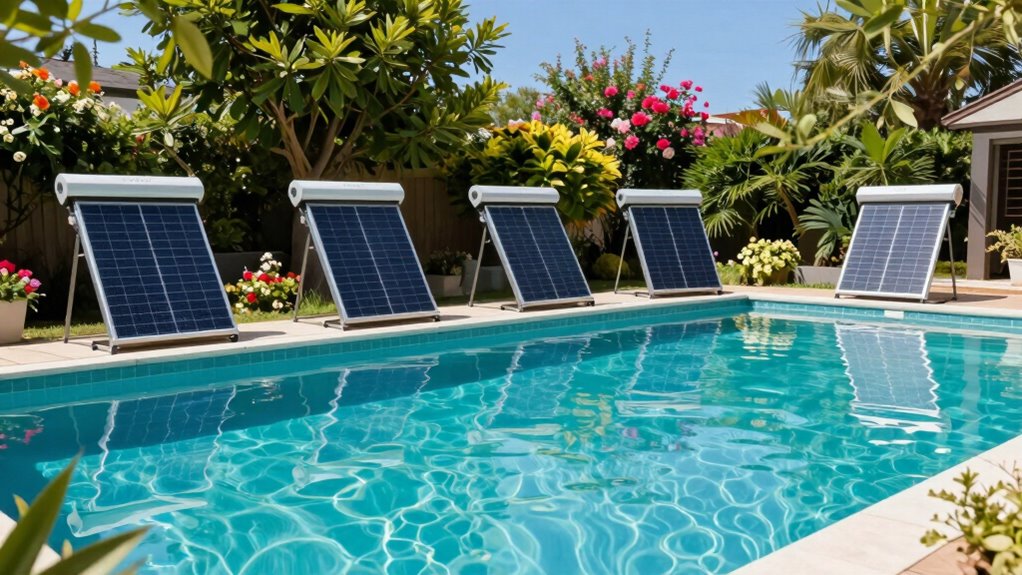

Choosing a solar pool heater for a 20,000-gallon pool means first separating true solar collectors from electric heat pumps. My strongest capacity-focused options here are the Solareast 71,000 BTU heat pump and VARMINPOOL 65,000 BTU heat pump: both list pools up to 20,000 gallons and provide controllable heating, but they need 220–240V power rather than sunlight alone. For a passive-solar approach, Doheny’s 2.5-by-20-foot collector offers a larger collector footprint than the compact mats, though its listed 40,000 BTU output is not a guarantee that one collector will heat a pool this size quickly.

Get pool and patio gear delivered free with Prime
- Fast, free delivery on millions of items
- Prime Video, Amazon Music and more included
- Member-only deals all year
The central tradeoff is capacity versus energy source. The Goplus system and Intex mat rely on sunlight, but their stated pool capacities are far below 20,000 gallons. The heat pumps are more plausible as primary heaters at this pool size, yet they consume electricity, require substantial installation planning, and are not solar collectors. I rank these products by how honestly their stated capacity, heating approach, and installation requirements fit the needs of a 20,000-gallon pool—not by treating every product labeled “solar” as interchangeable.
Complete the kit


Key Takeaways
- For a pool near 20,000 gallons, the Solareast and VARMINPOOL are the only listed options whose stated capacities reach that size; both are 220–240V heat pumps, not direct solar collectors.
- Solareast lists 71,000 BTU and a maximum COP of 15.8, but its product details conflict between 20,000- and 14,000-gallon suitability, so confirm sizing before choosing it.
- VARMINPOOL has a clearer stated 20,000-gallon limit and weighs 110 pounds, but it still needs a dedicated electrical setup and does not include solar panels.
- Doheny’s 40,000-BTU collector has the largest stated collector length among the solar-only options, but pipes and a mounting kit are separate and output depends on sun and system design.
- Goplus and Intex are better treated as smaller-pool or supplemental heaters: their stated capacities are 3,408 and 8,000 gallons, respectively, not 20,000.
| Solareast 71,000 BTU Inverter Pool Heat Pump with WiFi |  | Best Overall for Capacity and Remote Control | Heating capacity: 71,000 BTU | Listed pool capacity: Up to 20,000 gallons; other product details also mention up to 14,000 gallons | Maximum COP: 15.8 | VIEW ON AMAZON | See Our Full Breakdown |
| VARMINPOOL 65,000 BTU Pool Heat Pump for Inground and Above-Ground Pools |  | Best Clear-Capacity Alternative | Heating capacity: 65,000 BTU | Pool capacity: Up to 20,000 gallons | Power: 220–240V/60Hz; 18A | VIEW ON AMAZON | See Our Full Breakdown |
| Doheny’s Solar Heating System for Above-Ground Swimming Pools, 2.5′ x 20′ Collector Kit |  | Best Dedicated Solar Collector | Collector size: 2.5 feet wide by 20 feet long | Listed heat output: 40,000 BTU | Pool type: Above-ground swimming pools | VIEW ON AMAZON | See Our Full Breakdown |
| Goplus Solar Pool Heater, 2.5 ft x 10 ft |  | Best Portable Solar Add-On for Smaller Pools | Panel configuration: Two PE panels, each 2.5 by 10 feet | Maximum stated pool capacity: 3,408 gallons | Stated temperature increase: Up to 10.8°F, subject to conditions | VIEW ON AMAZON | See Our Full Breakdown |
| Intex Solar Pool Water Heater Mat for Above-Ground Pools |  | Best Compact Seasonal Mat | Surface area: 11 square feet | Flat dimensions: 47.25 by 47.25 inches | Pool capacity: Up to 8,000 gallons | VIEW ON AMAZON | See Our Full Breakdown |
| solar pool heater for 20000 gallon pool | Weight |
|---|---|
| Solareast 71,000 BTU Inverter | 140.7 pounds |
| VARMINPOOL 65,000 BTU Pool Hea | 110 pounds |
| Doheny’s Solar Heating System | — |
| Goplus Solar Pool Heater | — |
| Intex Solar Pool Water Heater | 6.41 pounds |
More Details on Our Top Picks
Solareast 71,000 BTU Inverter Pool Heat Pump with WiFi
For a 20,000-gallon pool, this is the most capable-looking option in the lineup on paper: it lists 71,000 BTU, inverter operation, and suitability for pools up to 20,000 gallons. It also heats and cools, a useful distinction if you want temperature control beyond extending the swimming season. The WiFi app supports settings and schedules, while the stated maximum COP of 15.8 describes its rated efficiency under specified conditions—not a promise of the same result in every climate or operating setup.
There is an important qualification: the product information also mentions systems up to 14,000 gallons. That conflict makes this a less straightforward capacity choice than VARMINPOOL, whose listing consistently names 20,000 gallons. I would ask the seller or installer to confirm the sizing basis for my pool before buying. At 140.7 pounds and 220–240V, this is also a fixed-installation project, not a portable solar panel. Compared with Doheny’s collector, it can offer more active, controlled heating, but it needs electrical power and does not directly harvest pool-heating energy from sunlight.
Its advantage over the lower-output VARMINPOOL is the higher listed BTU capacity and broader stated operating features, including a wider listed ambient range down to 5°F. Its drawback is the conflicting pool-size information and greater weight. I place it first because it is the strongest candidate for someone who wants a powered primary heater sized around this pool volume, provided the capacity discrepancy is resolved before purchase.
Pros:- Lists 71,000 BTU and up to 20,000-gallon pool compatibility.
- Provides both heating and cooling modes with WiFi app control.
- Inverter design, automatic defrost, and a stated maximum COP of 15.8.
- Supports above-ground and inground pools, including fresh and salt water.
Cons:- Product details conflict between 20,000- and 14,000-gallon pool suitability.
- Requires 220–240V power and weighs 140.7 pounds.
- It is an electric heat pump, not a direct solar thermal collector.
Best for: Owners of a 20,000-gallon pool who want app scheduling, heating and cooling, and are prepared to verify sizing and arrange 220–240V installation.
Not ideal for: Buyers seeking a standalone, sunlight-powered collector, a lightweight unit, or a capacity claim with no conflicting product details.
- Heating capacity:71,000 BTU
- Listed pool capacity:Up to 20,000 gallons; other product details also mention up to 14,000 gallons
- Maximum COP:15.8
- Power:220–240V
- Temperature modes:Heating 47–104°F; cooling 47–83°F
- Controls:LCD touch panel and WiFi app
- Weight:140.7 pounds
- Pool compatibility:Above-ground and inground; fresh water and salt water
Our verdict“My leading capacity-oriented pick if the seller confirms that the 71,000-BTU model is correctly sized for your 20,000-gallon pool.”
VARMINPOOL 65,000 BTU Pool Heat Pump for Inground and Above-Ground Pools
VARMINPOOL is my more straightforward alternative to Solareast for a pool close to 20,000 gallons. Its listing specifies 65,000 BTU and capacity up to 20,000 gallons without the competing pool-size figure included in the Solareast details. That does not prove it will reach a particular temperature in every setting, but the published sizing is easier to interpret. It also supports both heating and cooling, freshwater and saltwater, WiFi control, and a programmable timer.
The tradeoff is that it gives up some listed heating capacity compared with Solareast, and it still needs a 220–240V, 18A supply. At 110 pounds, it is lighter than Solareast but remains a substantial appliance that needs a planned location and proper installation. The product can connect to a compatible solar power system, but the solar panels are not included; that is different from a water-heating collector like Doheny’s. Buyers should not read “solar” here as off-grid or sunlight-only pool heating.
Compared with the Goplus and Intex products, VARMINPOOL is in a different capacity class for this pool size, but it brings electrical complexity and a larger equipment footprint. Its minimum operating ambient temperature is listed at 10°F, while Solareast lists operation down to 5°F. I rank it second because it offers a clear 20,000-gallon claim and useful controls, with fewer sizing ambiguities than my first pick, while its lower BTU rating and power requirements keep it from being an uncomplicated choice.
Pros:- Lists 65,000 BTU and pool capacity up to 20,000 gallons.
- Provides heating and cooling with WiFi app control and a programmable timer.
- Works with freshwater and saltwater pools.
- Includes auto defrost, IPX4 housing, and safety protections.
Cons:- Requires 220–240V power and lists an 18A current requirement.
- Solar panels are not included; this remains an electric heat pump.
- Its 65,000-BTU rating is lower than Solareast’s listed 71,000 BTU.
Best for: Pool owners who want an app-controlled heat pump with a clear stated 20,000-gallon limit and can provide 220–240V power.
Not ideal for: Anyone wanting a true solar thermal collector, a low-voltage system, or included solar panels.
- Heating capacity:65,000 BTU
- Pool capacity:Up to 20,000 gallons
- Power:220–240V/60Hz; 18A
- Temperature modes:Heating 46–104°F; cooling 46–82°F
- Minimum operating ambient temperature:10°F
- Controls:WiFi app and programmable timer
- Weight:110 pounds
- Solar panels:Not included
Our verdict“My clearest listed 20,000-gallon heat-pump alternative for buyers who value straightforward sizing and remote controls over a direct solar collector.”
Doheny’s Solar Heating System for Above-Ground Swimming Pools, 2.5′ x 20′ Collector Kit
If I wanted water heated directly by sunlight rather than an electric heat pump, Doheny’s is the most substantial collector in this group. Its 2.5-by-20-foot collector is longer than the Goplus panel set and offers a listed 40,000-BTU output. For a 20,000-gallon pool, that makes it a more plausible solar starting point than the Intex mat, but one collector should not be treated as a guaranteed whole-pool solution. The required collector area depends on climate, exposure, pool cover use, and the temperature increase you expect.
The package is not a complete, ready-to-connect installation: PVC or flex pipe and mounting hardware are not included, and a roof or rack mounting kit is required. That can add design work and installation expense, especially if the roof angle, available sun, or plumbing route is poor. In comparison, Goplus includes several connection accessories and can be placed on the ground or an inclined frame, but its stated maximum pool capacity is only 3,408 gallons. Doheny offers a larger collector format, while leaving more of the mounting and plumbing decisions to the buyer.
This is my best choice among the actual solar thermal products for someone committed to using sunlight and willing to build a suitable circulation setup. It is still an above-ground-pool system by its product title, and buyers with a 20,000-gallon pool should confirm the required collector area and pump compatibility with the manufacturer or installer. I would skip it if I needed predictable heating regardless of weather or wanted all fittings and mounting parts in the box.
Pros:- Uses solar thermal collection rather than an electric heat-pump cycle.
- The 2.5-by-20-foot collector is larger than the compact solar options listed here.
- Lists 40,000 BTU output.
- Can help extend the swimming season when sunlight and system sizing are adequate.
Cons:- PVC or flex pipe is not included.
- A roof or rack mounting kit is required and not included.
- No explicit 20,000-gallon capacity is given, and output depends on sun and system design.
Best for: Owners seeking a direct solar collector for an above-ground pool who can plan mounting, plumbing, and potentially additional collector area.
Not ideal for: Buyers who need a turnkey heater sized explicitly for 20,000 gallons, lack a sunny mounting location, or want included piping and hardware.
- Collector size:2.5 feet wide by 20 feet long
- Listed heat output:40,000 BTU
- Pool type:Above-ground swimming pools
- Mounting:Roof or rack mounting kit required
- Included plumbing:PVC pipe and flex pipe are not included
- Item weight:24 pounds
- Manufacturer:Doheny’s
Our verdict“My strongest direct-solar option here, but treat it as a collector component whose suitability for 20,000 gallons needs a sizing plan.”
Goplus Solar Pool Heater, 2.5 ft x 10 ft
Goplus is a flexible solar collector set rather than a credible standalone heater for a 20,000-gallon pool. It includes two 2.5-by-10-foot PE panels, connection accessories, and several placement options: ground, inclined frame, or roof. The product states a temperature increase of up to 10.8°F, but that figure depends on conditions and should not be read as a guaranteed rise for a pool this large. More telling for sizing is its stated maximum pool capacity of 3,408 gallons.
That capacity puts it well below Doheny’s as a primary-heating candidate for this roundup. Its advantages are portability and more included connection pieces, while Doheny provides a longer collector and a stated 40,000-BTU output. Goplus also supports above-ground and inground pools, but the pump is not included; the product recommends at least 0.75 HP and no more than 21 PSI. A buyer needs to check that the existing circulation equipment stays within those limits and that the plumbing adapters match.
I would consider it for a smaller pool, a temporary setup, or supplemental solar warming alongside another heater—not as the sole answer to heating 20,000 gallons. The roll-up format makes seasonal storage easier than a fixed collector installation, but it does not overcome the low stated pool capacity. Compared with the Intex mat, it provides a two-panel arrangement and broad placement options, while Intex gives a smaller, simpler folding mat with compatibility limits tied to pump flow.
Pros:- Includes two roll-up PE panels and multiple connection accessories.
- Can be placed on the ground, an inclined frame, or a roof.
- Compatible with both above-ground and inground pools.
- Portable format is easier to store than a fixed collector.
Cons:- Listed maximum pool capacity is only 3,408 gallons.
- Water pump is not included and must meet stated power and pressure guidance.
- Claimed temperature rise depends on available sunlight and conditions.
Best for: Owners of a smaller pool or buyers adding portable solar warming alongside an existing heater.
Not ideal for: Anyone expecting one kit to heat a 20,000-gallon pool or who lacks a compatible pump and suitable sunny space.
- Panel configuration:Two PE panels, each 2.5 by 10 feet
- Maximum stated pool capacity:3,408 gallons
- Stated temperature increase:Up to 10.8°F, subject to conditions
- Pool compatibility:Above-ground and inground
- Installation options:Ground, inclined frame, or roof
- Pump:Not included; recommended at least 0.75 HP and no more than 21 PSI
- Included accessories:End caps, clamps, connector hoses, elbow connectors, and hose adapters
Our verdict“A useful portable solar add-on for smaller pools, but its stated capacity rules it out as the sole heater for 20,000 gallons.”
Intex Solar Pool Water Heater Mat for Above-Ground Pools
The Intex mat is the smallest and most limited option here, which is exactly why I would reserve it for a smaller above-ground pool or a supplementary warming circuit. It has an 11-square-foot surface and is described for pools up to 8,000 gallons. The stated 5–9-degree temperature increase depends on weather, so it should not be interpreted as the result a 20,000-gallon pool will receive from one mat. For this article’s pool size, its capacity figure is a firm reason not to rank it as a primary heater.
Its strengths are uncomplicated storage and compatibility details: the mat folds for winter, uses UV-stabilized PVC, and connects to specified pumps up to 1/3 HP or below 2,000 GPH. Adapters are included for 1.5-inch hoses, alongside the 1.25-inch hose attachment. Compared with Goplus, Intex is lighter and more compact, but Goplus offers two panels, more placement choices, and a higher listed temperature rise. Compared with Doheny’s long collector, the mat is easier to put away but far less compelling as a heating surface for a large pool.
I would choose it if storage space, a modest above-ground pool, and compatibility with the existing filter pump matter more than heating a large volume. A 20,000-gallon owner could look at multiple collector units only after checking pump-flow limits, plumbing, and manufacturer guidance; the supplied specifications do not establish that configuration as a supported solution. If dependable temperature control is the priority, the heat pumps are better suited, though they require electrical power.
Pros:- Folds for compact winter storage.
- Lightweight mat with UV-stabilized PVC construction.
- Includes adapters for 1.5-inch hoses.
- Provides stated compatibility guidance for pump power and flow.
Cons:- Designed for pools up to 8,000 gallons, far below this roundup’s target size.
- Heating depends on weather and available sunlight.
- Limited to above-ground pools and compatible low-flow pumps.
Best for: Owners of above-ground pools up to the stated 8,000-gallon limit who want a foldable seasonal solar mat.
Not ideal for: Owners of 20,000-gallon pools seeking a standalone heater or anyone with a pump outside the stated compatibility limits.
- Surface area:11 square feet
- Flat dimensions:47.25 by 47.25 inches
- Pool capacity:Up to 8,000 gallons
- Stated temperature increase:Approximately 5–9 degrees, depending on weather
- Compatible pump:Up to 1/3 HP or less than 2,000 GPH
- Material:Heavy-duty UV-stabilized PVC
- Weight:6.41 pounds
- Connections and storage:1.25-inch hose attachment, 1.5-inch adapters, folds for storage
Our verdict“A tidy seasonal choice for a smaller above-ground pool, but not a practical single-unit solution for 20,000 gallons.”

How We Picked
I ranked these options around the title’s actual use case: heating a 20,000-gallon pool, rather than simply finding products that use the word solar. I compared each product’s stated pool capacity, heat output or collector area, energy source, pool compatibility, and the installation pieces a buyer must supply. A capacity claim is a starting point, not a promise of a particular temperature rise; weather, wind, pool cover use, desired temperature, and daily sun exposure all affect real results.
I also separated solar thermal collectors from electric air-source heat pumps. The first three products circulate pool water through solar collectors and depend on sunshine. Solareast and VARMINPOOL use powered heat-pump technology; their solar connection or solar-related positioning does not make them standalone solar heaters. I gave capacity-fit options precedence for a 20,000-gallon pool, while still including smaller collectors for buyers seeking supplemental heat or planning a larger collector array. Product details supplied for Solareast contain conflicting pool-size guidance, so I treat that uncertainty as a real drawback rather than assuming the highest claim applies in every condition.
Finally, I weighed practical friction: pump and voltage requirements, included connections, mounting needs, portability, and missing components. I do not infer guaranteed heating times or savings from the listed specifications. The rankings reflect the information available and how well each option fits this particular pool size.
Factors to Consider When Choosing Solar Pool Heater For 20000 Gallon Pool
For a 20,000-gallon pool, I would start by deciding whether you need a primary heater or a solar supplement. Then match the system to the pool, the available power and sunlight, and the plumbing you can support.Check capacity before comparing temperature claims
A claimed temperature increase is meaningful only alongside pool volume, weather, operating time, and collector area. Goplus lists a maximum of 3,408 gallons and Intex lists up to 8,000 gallons, so neither is specified as a single-unit solution for 20,000 gallons. Doheny gives a collector size and BTU figure but no explicit pool-capacity rating. I would ask how much collector area is recommended for my location and pool before treating it as the primary heater. Solareast and VARMINPOOL list capacity up to 20,000 gallons, though Solareast’s details also mention 14,000 gallons.
Know what “solar” means for each system
A solar thermal collector uses sunlight to warm water moving through its panels. Doheny, Goplus, and Intex work in this category, so cloud cover and limited sun directly affect performance. The Solareast and VARMINPOOL units are electric heat pumps: they draw heat from outdoor air and use electricity to move it into pool water. VARMINPOOL can connect to a compatible solar power system, but panels are not included. If your requirement is heating without grid power, these heat pumps do not meet that goal by themselves.
Plan the installation around pump, plumbing, and voltage
For the solar collectors, check flow rate, pressure, hose diameter, mounting location, and the route back to the pool. Doheny requires separate pipe and mounting hardware; Goplus includes accessories but not its pump; Intex specifies a compatible pump range. Heat pumps bring a different set of needs: both listed models require 220–240V, and their weight calls for a stable location and planned plumbing. I would confirm electrical requirements with a qualified installer and compare the unit’s connection sizes with the pool system before ordering.
Set realistic expectations for weather and heat retention
Solar collectors deliver most when they receive strong, sustained sunlight. Wind, cool nights, shade, and uncovered water can quickly reduce the benefit. A pool cover can help retain heat, regardless of which heater you select, while a larger collector array may be needed if sunlight is your main energy source. Heat pumps can provide more controlled operation, but their output and efficiency also vary with ambient conditions. The specifications here do not establish a guaranteed daily temperature rise for a particular pool.
Choose between primary heating and supplemental warming
If you want a primary heater for a pool near 20,000 gallons, I would begin with the capacity-listed heat pumps and resolve the Solareast sizing conflict before choosing between them. If you prefer direct solar heating, Doheny is the stronger collector starting point in this group, but I would confirm the number of collectors and system design with an installer. Goplus and Intex fit better as smaller-pool solutions or supplementary collectors; their stated capacity limits make them poor standalone matches for this pool size.
Frequently Asked Questions
Can one solar pool heater in this list heat a 20,000-gallon pool?
The specifications do not establish any of the three direct solar collectors as a confirmed, single-unit solution for 20,000 gallons. Goplus lists up to 3,408 gallons and Intex up to 8,000 gallons. Doheny lists a 40,000-BTU collector but no pool-volume rating, so I would get a collector-area recommendation for the local climate and pool setup before relying on it alone. The two heat pumps list 20,000-gallon capacity, but they use electricity rather than direct solar thermal collection.
Which option is the closest match for a 20,000-gallon pool?
Solareast and VARMINPOOL are the closest matches by their stated pool capacities. Solareast lists 71,000 BTU and up to 20,000 gallons, but its product details also mention 14,000 gallons, so I would get written sizing confirmation. VARMINPOOL lists 65,000 BTU and up to 20,000 gallons without that conflicting figure. Both require 220–240V power and should be viewed as heat pumps, not solar collectors.
Are the Solareast and VARMINPOOL heaters powered by solar panels?
They are electric heat pumps. Solareast uses inverter air-source technology, while VARMINPOOL can connect to a compatible solar power system; the VARMINPOOL listing says panels are not included. A solar electric array could potentially supply power as part of a broader setup, but these products are not direct solar water-heating collectors and their listings do not make them standalone off-grid heaters.
What should I check before installing a solar thermal collector?
I would verify the recommended collector area for a 20,000-gallon pool, available daily sun, pump flow and pressure limits, hose or pipe sizes, and mounting requirements. Doheny does not include PVC or flex pipe or a roof/rack mounting kit. Goplus includes connection accessories but not a pump, and Intex only supports specified pump power and flow. Confirm the plumbing layout and pool compatibility before connecting a collector to the circulation system.
Will a solar heater raise my pool temperature by the listed amount?
Not necessarily. Goplus states up to 10.8°F, and Intex gives approximately 5–9 degrees depending on weather, but those figures should not be assumed for every pool volume, climate, or installation. Sun exposure, wind, overnight cooling, circulation, collector area, and whether the pool is covered all affect the outcome. I would treat listed temperature increases as conditional product claims, not guaranteed results for a 20,000-gallon pool.
Conclusion
For a 20,000-gallon pool that needs a primary heater, I would compare Solareast and VARMINPOOL first. Solareast has the higher listed output and more operating-range detail, but I would buy only after confirming which capacity claim applies. VARMINPOOL is my simpler capacity-listed alternative if 220–240V power is available. If avoiding direct electric pool heating matters most, Doheny is my solar-thermal starting point, with the caveat that collector area, mounting, and piping need a separate plan. I would reserve Goplus for a smaller pool or supplemental warming and choose Intex for a compact seasonal mat on a suitably small above-ground pool. For all five, match the published limits to the pool and installation rather than relying on a temperature-rise claim alone.